• Skip to primary navigation
  • Skip to main content
  • Skip to primary sidebar

Spencer Critchley

  • Home
  • About
  • Media Appearances
    • Broadcast Appearances
    • Print & Web Coverage
    • My Reporting & Commentary
    • Podcast
    • “Saving Democracy” Events
    • News: Real or Fake?
    • Hallmarks of a #BadArgument
  • Music
  • Photos
  • Subscribe
  • Contact

Politics & Society

A Car Wash for Souls

November 18, 2017 by Spencer Critchley

Vintage car wash sign, shaped something like a cross
Photo: iStock

[Also published at Huff Post.] I had Christianity all wrong — I thought Jesus didn’t want you to sin.

Yes, if you did sin, He would forgive you. But the baseline was, Jesus was anti-sin.

Well now Christian supporters of Roy Moore and Donald Trump have shown me the error of my ways.

It turns out His forgiveness isn’t an exception — it’s a license.

Stalking little girls? P***y-grabbing? Do it! All you have to do is show up in church of a Sunday, and you are good to go, Monday through Saturday.

Sin-sin-sin-sin-sin-sin-“I love you, Jesus!”-sin-sin-sin-sin-sin-sin.

Defending Roy Moore, Pastor Mark Burns explained it to Joy Reid Saturday morning: “Morality isn’t the only quality that makes a good leader.” Even King David, he explained, had been quite a sinner, and Jesus was the only perfect man ever to walk the Earth.

And Jesus’ job is to forgive the rest of us.

I feel so stupid for not getting how this really works — and how you can work it.

The good news is, this revelation has led me to a new business idea — and I’ve been checking out the Prosperity Gospel, too, so I’m sure I’m on the right track here.

I’m calling it the Car Wash for Souls™.

Check it out. You see, it’s great that all this sinning is allowed, but there’s no need to make it so inconvenient. In the Car Wash for Souls™, it’s all right there for you.

As you enter, they’ll stick a drink in your hand and a pretty girl in your lap. And just like that, you’re off, working through all the sins you can ask Jesus to eat: lust, intemperance, lying, cheating, stealing — you name it.

There’ll even be some you don’t want to name. We’ll call the really embarrassing ones Mystery Sins™. They’ll happen in a dark room, and no one ever has to know.

But the kicker comes at the last stop on your way out: We’ll have a pastor right there to forgive you! Won’t take a minute; he can do it while you pay.

It can’t miss.

And if it does, well sorry, investors, and I love you, Jesus!
Filed Under: Politics & Society Tagged With: Christianity, Donald Trump, Religion, Roy Moore

Yes, Judge What Happened In Charlottesville — And Then What?

August 13, 2017 by Spencer Critchley

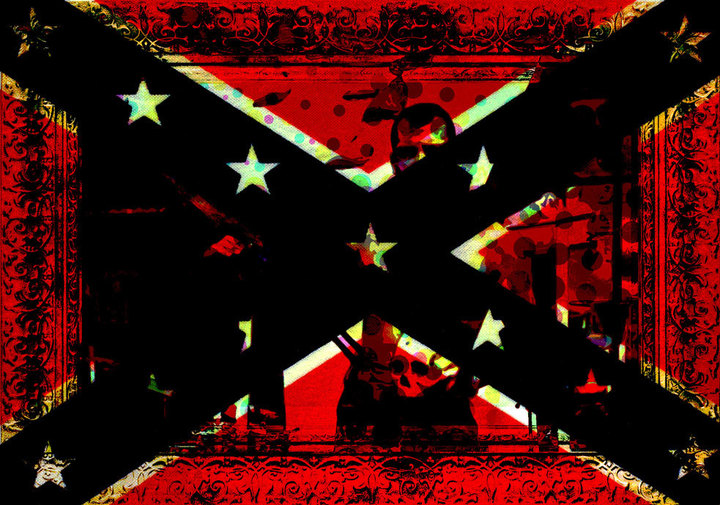
Confederate flag photo illustration
AK Rockefeller, Foter.com

[Also published at Huffington Post.] We have to call out horrors like what happened yesterday, and there’s value in doing it: to make it clear what America is and what it cannot be.

At the same time, I think there’s also a risk in having such obvious villains as Nazis and KKK members to point to, because it’s so easy to denounce them, feel good about ourselves, and move on.

In day-to-day life, people don’t wear swastikas. Almost no one thinks of themselves as a bigot. But we all have at least some fear or hatred of others within us. If we refuse to see it, we create an internal darkness similar to the one that allows bigotry to grow in society as a whole.

And whatever’s going on inside each of us, it’s what each of us does that matters. Judging others just distracts us from what matters.

Warning, it’s about to look like I’m going to blame the other party, feel good, and move on ― if you think that, please read on to, “And we Democrats…”

Right now it matters that Republican leaders don’t just make stronger statements than Trump’s ― an easy test to pass ― but that they stop acting to enable bigotry. They do that not just by supporting Trump’s bigoted policies, but by advancing their own, like their longstanding efforts to suppress the minority vote under the pretense of stopping nearly nonexistent voter fraud.

And individual Republicans, whatever they feel in their hearts, need to stop enabling a Republican Party that has welcomed racists since the mid-1960s. The Nixon campaign designed the Southern Strategy, and the party kept on using it, even after former GOP chair Ken Mehlman apologized for it. Under the Southern Strategy, explicit racial slurs were replaced with code phrases like “states rights,” “welfare cheats,” and “law and order.” The only difference with Trump is that he has dropped the veil that had been hiding the naked racism.

And we Democrats should be careful of using Republican bigotry as a free pass. Yes, our party has been on the right side of civil rights since the ’60s. I’m not suggesting a false equivalence. But there are issues like affordable housing, for example, in which many liberals support zoning regulations that have the effect of keeping neighborhoods segregated, without anyone having to look too hard at how it happens.

The challenge is to see clearly, especially when it’s uncomfortable ― it’s so much easier to see where other people are falling short ― and more importantly, to do things that make a difference.

So of course we have to call out horrors like Charlottesville. But we also have to be able to talk openly and usefully among ourselves, when there isn’t such obvious evil to decry, and find ways to change things that need to change. I think that means avoiding the distracting temptation to judge each other ― at worst, getting into ever-escalating moral purity contests ― and it also means avoiding the temptation to judge ourselves.

See ourselves, yes. But too often judgment is like a heat sink ― energy that could be used for change just gets converted to guilt, and lost.

None of us is morally pure. But each of us, in all our impurity, can make things better.

Filed Under: Politics & Society Tagged With: Donald Trump, racism

Arguing Over Their New Slogan Is Why Democrats Lose

August 7, 2017 by Spencer Critchley

Man straightening tie photo illustration
iStock

Democrats, being Democrats, are having a big argument right now about their new slogan, “A Better Deal.”

Is it on point? Does it suck? What do the polls say?

It doesn’t freaking matter.

Quick, now. What was Barack Obama’s slogan in 2012? George W. Bush’s in 2000 and 2004? Bill Clinton’s in ’92 and ’96?

You don’t remember. And it doesn’t matter.

Ah, but I bet you think you remember the Obama ‘08 slogan. “Hope and Change,” right? Actually he had at least four: “Hope,” Change,” “Change We Can Believe In,” and “Change We Need.”* They didn’t matter — until Obama made them matter.

You know what else doesn’t matter? Logos. Obama didn’t even like his now-iconic ’08 logo when he first saw it.

“It’ll do,” he said. And he was right. So would have lots of others.

People don’t vote for slogans. They don’t vote for logos. They vote for strong leaders who share their values.

Who fights over a slogan? Not leaders.

Fighting over the slogan — and all the related fussing over polls, focus groups, policy details — only signals voters that Democrats are obsessed with little stuff. Leaders are not obsessed with little stuff.

Leaders are focused on their vision of a better future, and they have the personal presence to inspire us with that vision.

It’s in that presence that leaders make their case. Democrats trying to figure out how to win need to stop trying to figure it out. They need to discover the world below their necks.

Then they might stumble across why Kentucky Congressional candidate Amy McGrath has exploded onto the national stage with her first campaign commercial. Holy smokes, there’s a leader.

Quick quiz: What’s her slogan?

Answer: Who cares?

*Want more presidential campaign slogan trivia? Here’s a list.

Filed Under: Communication, Leadership & Management, Politics & Society Tagged With: Democratic Party, politics

How Kellyanne Conway Won Her Debate With CNN’s Brian Stelter — Despite Being Wrong About Everything

July 24, 2017 by Spencer Critchley

[Also published at Huffington Post.] White House counselor Kellyanne Conway and “Reliable Sources” host Brian Stelter had a widely anticipated debate Sunday about the fairness of media coverage of the Trump administration. On every point that came up, Stelter exposed Conway as, at best, misleading.

And yet to some viewers, she was the clear winner.

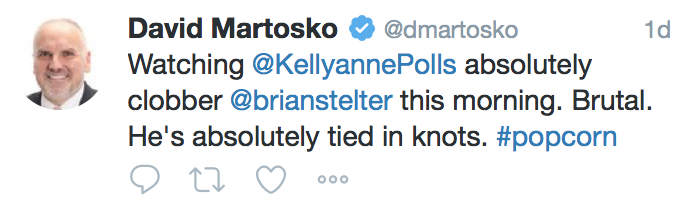
Tweet by David Martosko: "Watching @KellyAnnPolls absolutely clobber @BrianStelter this morning. Brutal. He's absolutely tied in knots."

How? Stelter and Conway were playing entirely different games.

For Conway, the audience was President Trump and the 36 percent of Americans who still trust him. Speaking past Stelter and connecting with them, she followed the rules of a game defined back in the 60s by the media consultants of the 1968 Nixon for President campaign.

One of them was the eventual founder of Fox News, Roger Ailes. Here’s Ailes in 1970, explaining why Nixon was seen to have lost his 1960 TV debate with John F. Kennedy despite many people believing he had won on the merits:

I think that the lighting was bad. It was experimental at best and sloppily done. His makeup was bad. I think he was tired–and this may have shown in his reaction and response.

I think that before the debates, John Kennedy spent the entire day briefing himself and relaxing, concentrating on the TV encounter.

Mr. Nixon did not do that. He walked in and handled it as if it were any other telecast.

Mr. Nixon, in a sense, stuck to the old school of debating, looking at Mr. Kennedy. But Mr. Kennedy looked at the camera, because he was essentially talking not to his opponent but to the people at home, and he was able to establish a kind of communication between himself and the home viewer. [Emphasis added.]

Ailes, along with other media and advertising experts, coached Nixon to be far more effective on TV for his winning 1968 campaign, and during his time in the White House.

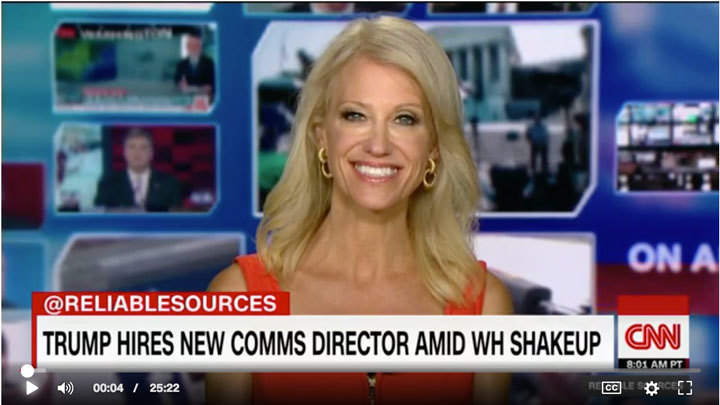
The rules they defined still apply, as you can see by analyzing the video of the Stelter-Conway interview. Let’s start with the splash frame from CNN.com:

Kelly Ann Conway on CNN

Conway looks happy, relaxed, and confident, is well lit by studio lighting, and is wearing red, a power color.

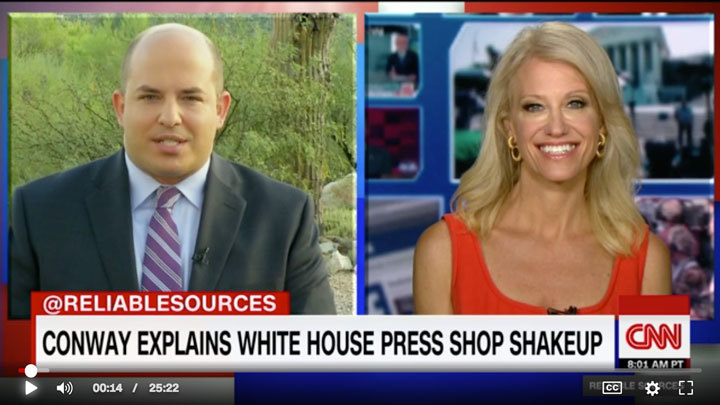
Now let’s look at her in split screen with Stelter:

Brian Stelter & Kelly Ann Conway on CNN

Oh oh. Just seconds in, and Stelter’s losing already.

How do we know? Let’s count the ways.

  1. Kelly is being shot straight on, so she can make direct eye contact through the camera with the viewer. Meanwhile Stelter is being shot from slightly above, so he has to look up. This unavoidably signals submissiveness, no matter what he’s saying. Our brains can’t help but make the unconscious connection: small, less powerful people look up at bigger, more powerful people.
  2. Stelter isn’t as well lit. Compared to Conway, he looks washed out. She, meanwhile, is being sculpted by highlights and eyelights.
  3. He’s wearing more muted colors, dominated by grey.
  4. He appears to be outside, in some random grassy environment (he was in Tucson, on the first day of a family vacation, according to his Twitter feed.) It feels like he’s both literally and symbolically on the outside, while she’s on the inside, in the impressive environment of a CNN studio.
  5. As you play the video, you’ll hear that his sound is weaker as well — and occasional bird tweets don’t help.

And so it goes throughout the interview. As Stelter tries to pin Conway down on one misdirection after another, she just moves blithely on to the next. And each of his sallies feels, I’m sorry to say, “low energy.” At pains to preserve the standards of civil discourse, he repeatedly reassures her of his respect, while she turns her responses into digs at him and CNN.

One example among many:

Stelter: “The scandals are about the president’s lies. About voter fraud, about wire-tapping, his repeated lies about those issues. That’s the scandal.”

Conway: “He doesn’t think he’s lying about those issues.”

It’s OK because he doesn’t think he’s lying? On the page, Conway’s response is ridiculous. But on TV, she looks and sounds unruffled and in control.

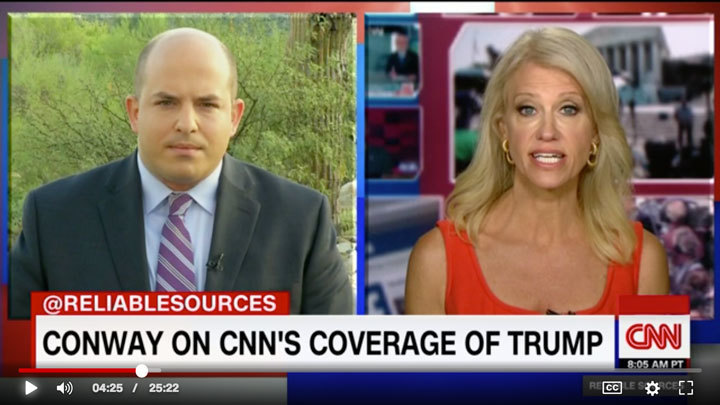
Stelter, on the other hand, comes across as alternately tentative, frustrated, and confused:

Brian Stelter & Kelly Ann Conway on CNN

On TV, impressions are what matter much more than words — as Conway’s boss could tell you, you win by looking like you’re winning.

CBS correspondent Lesley Stahl has often told the story of how she learned this lesson from a Reagan administration official back in 1984. Here’s how she related it to Bill Moyers in a 1989 interview:

I did a piece that was-where I was quite negative, to be honest with you, about Reagan. And yet the pictures were terrific, and I thought they’d be mad at me, but they weren’t. They loved it. And the official outright said to me, “They didn’t hear you. Didn’t hear what you said. They only saw those pictures.” And what he really meant was it’s the visual impact that overrides the verbal.

And that’s what happened, yet again, here.

Filed Under: Communication, Journalism, Politics & Society Tagged With: Donald Trump, journalism, media

America Is A Creed, Not a Tribe — And Too Few Americans Know Why That Matters

July 10, 2017 by Spencer Critchley

Statue of Liberty at night
0X010C via Wikimedia Commons

[Also published at Huffington Post.] Donald Trump’s recent speech in Poland sent chills down the spines of people around the world who believe in small l, small d liberal democracy. Notably this part:

We must work together to confront forces, whether they come from inside or out, from the South or the East, that threaten over time to undermine these values and to erase the bonds of culture, faith and tradition that make us who we are. If left unchecked, these forces will undermine our courage, sap our spirit, and weaken our will to defend ourselves and our societies.

What’s so disturbing? Many Trump supporters honestly see no problem — why shouldn’t we defend America, in partnership with our allies?

Because what Trump is describing here isn’t America. And sadly, many Americans failed to notice.

America, as patriots (including me) like to point out, is exceptional. But if some of those patriots don’t see the problem in what Trump said in Poland — and has said in other, starker, ways — then I submit they don’t understand why America is exceptional.

Because it isn’t bonds of culture, faith, and tradition that “make us who we are” — and it certainly isn’t xenophobic opposition to the South or the East, in defense of an ethnocentric West. Culture, faith, and tradition are important in all countries. But in America, they’re not essential. Those things are essential only to the nations of the past: nations that were formed from tribes.

What’s exceptional about America is that it isn’t a tribe. It’s a creed.

You’re not an American because of your blood, or the soil on which you were born, or the religion you practice. You’re an American because you believe in the American creed. That’s the essential miracle of this country.

The creed was defined in the Preamble to the Declaration of Independence, which its author Thomas Jefferson intended as “an expression of the American mind,” and which, as I hope we all still remember, begins with these words:

We hold these truths to be self-evident, that all men are created equal, that they are endowed by their Creator with certain unalienable Rights, that among these are Life, Liberty and the pursuit of Happiness.

It’s why Jefferson built his first Inaugural Address to lead to this climax:

These principles [freedom of religion; freedom of the press; and freedom of person, and others] form the bright constellation, which has gone before us and guided our steps through an age of revolution and reformation. The wisdom of our sages, and blood of our heroes have been devoted to their attainment: they should be the creed of our political faith; the text of civic instruction… (Emphasis added.)

It’s why Abraham Lincoln summoned that creed anew to mark the end of the Civil War:

Four score and seven years ago our fathers brought forth on this continent, a new nation, conceived in Liberty, and dedicated to the proposition that all men are created equal.

It’s why Emma Lazarus wrote her sonnet for the Statue of Liberty, depicting it as a “New Colossus”: a symbol not of nationalistic conquest, like the ancient Colossus of Rhodes, but of the far greater power of democratic values:

Not like the brazen giant of Greek fame, With conquering limbs astride from land to land; Here at our sea-washed, sunset gates shall stand A mighty woman with a torch, whose flame Is the imprisoned lightning, and her name MOTHER OF EXILES. From her beacon-hand Glows world-wide welcome; her mild eyes command The air-bridged harbor that twin cities frame.

“Keep, ancient lands, your storied pomp!” cries she With silent lips. “Give me your tired, your poor, Your huddled masses yearning to breathe free, The wretched refuse of your teeming shore. Send these, the homeless, tempest-tost to me, I lift my lamp beside the golden door!”

It’s why in 1918 William Tyler Page and the U.S. Congress sought to inspire American soldiers with “The American Creed”:

I believe in the United States of America as a government of the people, by the people, for the people; whose just powers are derived from the consent of the governed; a democracy in a republic; a sovereign Nation of many sovereign States; a perfect union, one and inseparable; established upon those principles of freedom, equality, justice, and humanity for which American patriots sacrificed their lives and fortunes…

And it’s why the British poet G.K. Chesterton described America as “the only nation in the world that is founded on a creed.”

In a land where religion and the state are carefully separated — for the protection of both — the creed is the basis of what has been called our civil religion.

In Poland, Trump was speaking words of ethnic nationalism. They are words that could describe many countries.

But not America.

They are the words of someone who doesn’t know what America is.

Filed Under: Politics & Society Tagged With: democracy, Donald Trump

  • « Go to Previous Page
  • Page 1
  • Interim pages omitted …
  • Page 18
  • Page 19
  • Page 20
  • Page 21
  • Page 22
  • Interim pages omitted …
  • Page 34
  • Go to Next Page »

Primary Sidebar

Search This Site

Broadcast Appearances

Spencer Critchley on Spectrum News 1 LA

Book

Patriots of Two Nations by Spencer Critchley
Kindle & paperback at Amazon. Audio book at Audible. EPUB format here.

New Music: Jailbreak

Cover image for the song "Jailbreak:" a ruined motel by the side of a lonely desert road.

Podcast

Dastardly Cleverness in the Service of Good

Social Media

Substack

YouTube

Music: The Critchleys

The Critchleys: Owen and Spencer Critchley

About Me

Spencer Critchley

Jump to Recent Posts

New Music: The Desert Mothers

The True Crisis

Outside in the Rain

The Liberal Backbone

Slowly and then all at once

On the Podcast: A Letter to a Friend Voting for Trump

“The War of the Worldviews” at TedX Pugwash

Recent Comments

  • terry rankin on “The War of the Worldviews” at TedX Pugwash
  • Spencer Critchley on Why Biden was right to link MAGA, the Confederacy & the Axis in his SOTU address
  • Spencer Critchley on Why Biden was right to link MAGA, the Confederacy & the Axis in his SOTU address
  • Scott Sexton on Why Biden was right to link MAGA, the Confederacy & the Axis in his SOTU address
  • Anonymous on Why Biden was right to link MAGA, the Confederacy & the Axis in his SOTU address

Photos

Spencer Critchley on Fox News' Cavuto
Barack Obama photo by Spencer Critchley
Bruce Springsteen photo by Spencer Critchley
Jay-Z photo by Spencer Critchley
Tiny American flag in crowd at political rally
Director Elizabeth Thompson & Composer/Audio Producer Spencer Critchley with the Emmy for the PBS documentary "Blink."

Find more photos here.

Privacy Policy

Learn how this site collects information and how you can control that.

© 2005–2026 Spencer Critchley