• Skip to primary navigation
  • Skip to main content
  • Skip to primary sidebar

Spencer Critchley

  • Home
  • About
  • Media Appearances
    • Broadcast Appearances
    • Print & Web Coverage
    • My Reporting & Commentary
    • Podcast
    • “Saving Democracy” Events
    • News: Real or Fake?
    • Hallmarks of a #BadArgument
  • Music
  • Photos
  • Subscribe
  • Contact

media

How TV Has Changed Us: Barr Didn’t Need to Make an Argument, Just a Video Clip

April 19, 2019 by Spencer Critchley

What we saw from Barr yesterday was a deeply cynical exploitation of how television has changed us. Barr wasn’t trying to make an argument — he knew he didn’t have to. Instead, he was just trying to make a video clip. 

I doubt if he was worried about anyone exposing the hollowness of his repeated assertions of “No collusion,” echoing those of his client. He had to know discovery was waiting within minutes of anyone reading the document he was about to release. But he could count on most of us not reading.

Instead, we consume video clips, which don’t even open a case before closing it. They sidestep thought altogether and function like incantations: “This is true because it becomes true when we say it.”

So the point of Barr’s appearance was only in the appearance itself, how he looked and sounded: the blandly reassuring mask of the bureaucrat, the measured rhythm and downward cadences, the podium, the suit, and the suits behind him.

The only flaw: one of those other suits, Rosenstein. We couldn’t know what was going through his mind, but we couldn’t escape how he looked: like someone staring into a mirror and discovering nothing there.
Filed Under: Communication, Journalism, Politics & Society Tagged With: Donald Trump, media, Mueller Report, television, william barr

How Kellyanne Conway Won Her Debate With CNN’s Brian Stelter — Despite Being Wrong About Everything

July 24, 2017 by Spencer Critchley

[Also published at Huffington Post.] White House counselor Kellyanne Conway and “Reliable Sources” host Brian Stelter had a widely anticipated debate Sunday about the fairness of media coverage of the Trump administration. On every point that came up, Stelter exposed Conway as, at best, misleading.

And yet to some viewers, she was the clear winner.

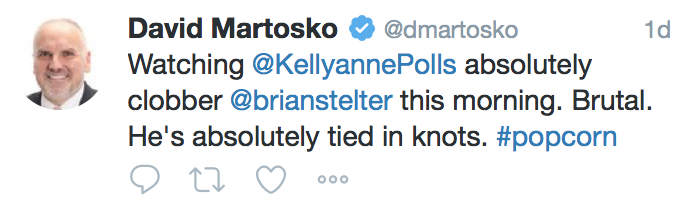
Tweet by David Martosko: "Watching @KellyAnnPolls absolutely clobber @BrianStelter this morning. Brutal. He's absolutely tied in knots."

How? Stelter and Conway were playing entirely different games.

For Conway, the audience was President Trump and the 36 percent of Americans who still trust him. Speaking past Stelter and connecting with them, she followed the rules of a game defined back in the 60s by the media consultants of the 1968 Nixon for President campaign.

One of them was the eventual founder of Fox News, Roger Ailes. Here’s Ailes in 1970, explaining why Nixon was seen to have lost his 1960 TV debate with John F. Kennedy despite many people believing he had won on the merits:

I think that the lighting was bad. It was experimental at best and sloppily done. His makeup was bad. I think he was tired–and this may have shown in his reaction and response.

I think that before the debates, John Kennedy spent the entire day briefing himself and relaxing, concentrating on the TV encounter.

Mr. Nixon did not do that. He walked in and handled it as if it were any other telecast.

Mr. Nixon, in a sense, stuck to the old school of debating, looking at Mr. Kennedy. But Mr. Kennedy looked at the camera, because he was essentially talking not to his opponent but to the people at home, and he was able to establish a kind of communication between himself and the home viewer. [Emphasis added.]

Ailes, along with other media and advertising experts, coached Nixon to be far more effective on TV for his winning 1968 campaign, and during his time in the White House.

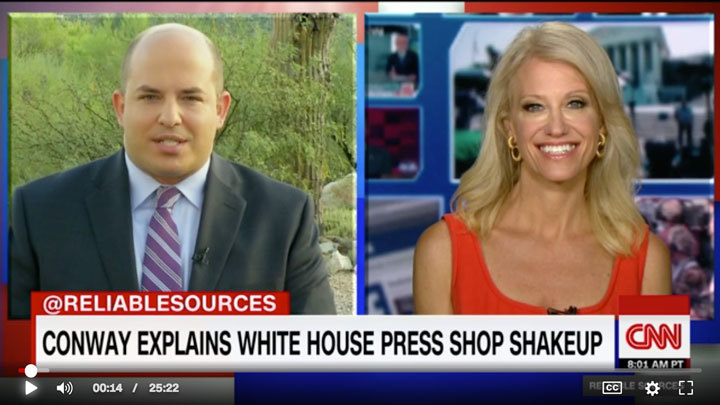
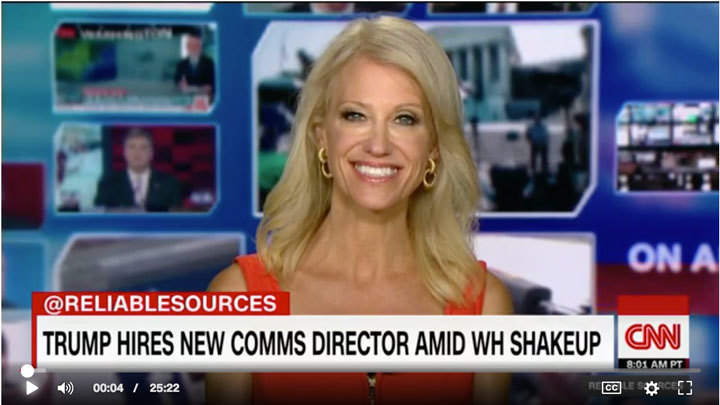
The rules they defined still apply, as you can see by analyzing the video of the Stelter-Conway interview. Let’s start with the splash frame from CNN.com:

Kelly Ann Conway on CNN

Conway looks happy, relaxed, and confident, is well lit by studio lighting, and is wearing red, a power color.

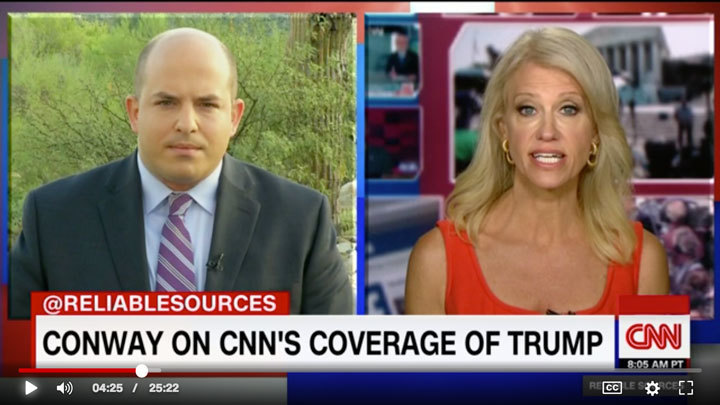
Now let’s look at her in split screen with Stelter:

Brian Stelter & Kelly Ann Conway on CNN

Oh oh. Just seconds in, and Stelter’s losing already.

How do we know? Let’s count the ways.

  1. Kelly is being shot straight on, so she can make direct eye contact through the camera with the viewer. Meanwhile Stelter is being shot from slightly above, so he has to look up. This unavoidably signals submissiveness, no matter what he’s saying. Our brains can’t help but make the unconscious connection: small, less powerful people look up at bigger, more powerful people.
  2. Stelter isn’t as well lit. Compared to Conway, he looks washed out. She, meanwhile, is being sculpted by highlights and eyelights.
  3. He’s wearing more muted colors, dominated by grey.
  4. He appears to be outside, in some random grassy environment (he was in Tucson, on the first day of a family vacation, according to his Twitter feed.) It feels like he’s both literally and symbolically on the outside, while she’s on the inside, in the impressive environment of a CNN studio.
  5. As you play the video, you’ll hear that his sound is weaker as well — and occasional bird tweets don’t help.

And so it goes throughout the interview. As Stelter tries to pin Conway down on one misdirection after another, she just moves blithely on to the next. And each of his sallies feels, I’m sorry to say, “low energy.” At pains to preserve the standards of civil discourse, he repeatedly reassures her of his respect, while she turns her responses into digs at him and CNN.

One example among many:

Stelter: “The scandals are about the president’s lies. About voter fraud, about wire-tapping, his repeated lies about those issues. That’s the scandal.”

Conway: “He doesn’t think he’s lying about those issues.”

It’s OK because he doesn’t think he’s lying? On the page, Conway’s response is ridiculous. But on TV, she looks and sounds unruffled and in control.

Stelter, on the other hand, comes across as alternately tentative, frustrated, and confused:

Brian Stelter & Kelly Ann Conway on CNN

On TV, impressions are what matter much more than words — as Conway’s boss could tell you, you win by looking like you’re winning.

CBS correspondent Lesley Stahl has often told the story of how she learned this lesson from a Reagan administration official back in 1984. Here’s how she related it to Bill Moyers in a 1989 interview:

I did a piece that was-where I was quite negative, to be honest with you, about Reagan. And yet the pictures were terrific, and I thought they’d be mad at me, but they weren’t. They loved it. And the official outright said to me, “They didn’t hear you. Didn’t hear what you said. They only saw those pictures.” And what he really meant was it’s the visual impact that overrides the verbal.

And that’s what happened, yet again, here.

Filed Under: Communication, Journalism, Politics & Society Tagged With: Donald Trump, journalism, media

Skip the Gut Check, Democrats: The Problem Is Hiding in Plain Sight

December 31, 2016 by Spencer Critchley

(Also published at Huffington Post.) Following a shock loss to what looked like the worst presidential candidate in history, many Democrats are agonizing over what policies they need to change in order to win back voters.

They needn’t bother: policy has almost nothing to do with it. Democrats can go left, right, more populist, less populist, or stay put.

Because for policies to make a difference, voters have to know what they are. And in every election, Republicans begin with a big gimme: millions of people are voting for and against things that don’t exist.

We’ve heard a lot over the years about the right-wing media bubble, and, more recently, the plague of fake news in social media feeds.

But for some reason, most analysts — and many Democratic politicians — seem to assume all this misinformation magically disappears in the voting booth. Most of the post-election debate seems to be about substantive factors that supposedly explain why otherwise reasonable people voted for Trump, like economic anxiety, fear of terrorism, or resentment of elitism. It’s like we have a rational investors theory of voter behavior.

But missing from the discussion is the big bloc of voters who were simply making a mistake, based on bad facts.

Consider just some of the reasons some people cite for rejecting the Obama legacy that Hillary Clinton ran on: “soaring deficits,” “job-killing economic policies,” “uncontrolled borders,” and “rising crime.”

None of these things is real.

Graph showing dramatic decline of violent crime since 1992.

  1. “Soaring deficits.” Actually, the deficit under President Obama has plummeted in every fiscal year except the most recent one. But in 2013, according to Pew, only 12 percent of Republicans knew the truth, and only 29 percent of Democrats – misinformation is leaky. The debt has in fact gone up, but that’s inevitable all the while you’re reducing deficits until you get them to zero, like Bill Clinton did.
  2. “Job-killing economic policies.” In fact, Obama holds the record for uninterrupted job growth, with more than 15 million jobs created to date, and has cut unemployment in half from its 2010 peak. But a 2015 Bloomberg survey found that 53 percent of Republicans believe unemployment has gotten worse. No doubt many are also unaware that corporate profits have set new records, the S&P 500 is up more than two and a half times, and inflation has been less than half the post World War II average, among other good economic news.
  3. ”Uncontrolled borders.” The truth is that illegal immigration has declined under Obama, while border enforcement, including deportations of criminals, has greatly increased. Meanwhile the data show that first generation immigrants, including ones here illegally from Mexico, commit less crime than native born Americans. But Pew found that 50 percent of Trump supporters believe undocumented immigrants are a serious crime threat that calls for more border security.
  4. “Rising crime.” In the real world, violent crime has been falling steadily since 1992. It’s now at the lowest level since 1970. But 79 percent of Republicans (65 percent of Democrats) think it’s rising, according to Gallup.

There are lots of other examples, like the fantasies that Obama is a foreign-born Muslim, climate change is a Chinese hoax, or Hillary deliberately let our people die in Benghazi.

Millions of Americans have been convinced of such things. In other words, millions of Americans are casting misguided votes.

If ballots were being altered, that would be a big story. In effect, they are.

As Obama told Bill Maher recently, “If I watched Fox News, I wouldn’t vote for me either.”

What to do? Obama provides a clue here too.

Because despite facing the same reality handicap, he won twice.

That means he was able to connect with some voters who otherwise would have voted against him based on faulty information (it goes without saying that some who did so were well-informed and just honestly disagreed with him).

How? By out-communicating the opposition.

People believe falsehoods because they feel true – Trump gets away with all his whoppers because they sound (and probably are) so authentically unfiltered.

What makes Obama a great communicator is that he can make the truth feel true: he connects the head and the gut.

And that’s the gut check Democrats need.

Filed Under: Communication, Journalism, Politics & Society Tagged With: Donald Trump, fake news, journalism, media

Who Says Trump Is Smart?

December 12, 2015 by Spencer Critchley

Donald Trump photo by Anythingyouwant, via Wikimedia CommonsDonald Trump’s ideas are widely recognized as not just hateful, but idiotic.

And yet the conventional wisdom in most of the media is that, all the same, “he’s a smart guy” — after all, look how successful he is. Even his liberal critics, including the very smart Rachel Maddow, give him credit: Trump may have no principles, but he obviously has brains.

A related line of thought holds that as a smart guy, he must know that what he’s saying is wrong in every way, so he can’t actually believe it, and must be saying it for purely political reasons.

But where is the evidence that he actually is intelligent? If he is, he also must be one of our most brilliant actors, because he’s completely convincing as a lout.

I suspect the reason so many journalists assume he’s only pretending to be stupid is that few of them know much about business — including how to judge business success.

Some examples:

1. Many journalists seem to think that making a lot of money is evidence of high intelligence. But anyone who’s worked in the corporate world can tell you different. Some senior executives are really smart, but many are more or less average. As research has shown, drive and social skills often count more than brains do.

You may have heard the old saying about college: It’s a place where former A students teach B students to work for C students.

2. Few journalists seem to understand how Trump makes his money. They accept his self-presentation as a genius builder. But for a long time it’s looked as if what Trump really does is just license his brand (for now).

He does have a talent for being famous, and that’s worth money. If you want to build something, he can make a lot of money by charging you to put his name on it. But that’s the same kind of “genius” that any celebrity shows when they put their name on perfume or sneakers.

3. There’s little reason to assume that Trump actually has nearly as much money as he claims. We have only his word for it — the word of one of the world’s most notorious fabricators. And as he himself has said, his net worth varies depending on how he feels.

Since a lot of his net worth seems to amount to brand equity, that actually, kind of, sort of, makes sense. I can tell you that the Critchley brand is worth not $10 billion — that’s Trump change — but $20 billion. Since I won’t take a penny less for it, I can claim it’s true.

In fact, I think I will. Would you like to loan me a half-billion or so? I have $20 billion in collateral.

4. Speaking of borrowing money, Trump has had to be bailed out repeatedly, with four corporate bankruptcies to his name. If you want to see someone who’s a genius at making money, take a look at the remarkably non-loutish Warren Buffett. As S.V. Dáte has pointed out, Buffett has used his investing acumen to beat the market about 22 times over during the time since Trump inherited a pile of money from his father. Trump, on the other hand, might have done better if he had put his windfall in an index fund and left it alone.

As I’ve watched Trump get cut all kinds of slack for saying the stupidest things imaginable, I’ve wondered if he just comes across as very different in person. Maybe those who have met him know something I don’t.

But Mark Bowden makes me think, “Nah.” For a profile he wrote for Playboy some years back, Bowden spent quite a bit of time with Trump. His impression, as described in the latest Vanity Fair, sure rings true:

Apart from the comical ego, the errors, and the self-serving bluster, what you get from Trump are commonplace ideas pronounced as received wisdom. Begin registering all Muslims in America? Round up the families of suspected terrorists? Ban all Muslims from entering the country? Carpet-bomb ISIS-held territories in Iraq (killing the 98-plus percent of civilians who are, in effect, being held hostage there by the terror group and turning a war against a tiny fraction of the world’s Muslims into a global religious crusade)? Using nuclear weapons? The ideas that pop into his head are the same ones that occur to any teenager angry about terror attacks. They appeal to anyone who can’t be bothered to think them through–can’t be bothered to ask not just the moral questions but the all-important practical one: Will doing this makes things better or worse? [My emphasis.]

Maybe we should take the advice of Maya Angelou: “When people show you who they are, believe them.”

Filed Under: Journalism, Politics & Society Tagged With: Donald Trump, journalism, media

Primary Sidebar

Search This Site

Broadcast Appearances

Spencer Critchley on Spectrum News 1 LA

Book

Patriots of Two Nations by Spencer Critchley
Kindle & paperback at Amazon. Audio book at Audible. EPUB format here.

New Music: Jailbreak

Cover image for the song "Jailbreak:" a ruined motel by the side of a lonely desert road.

Podcast

Dastardly Cleverness in the Service of Good

Social Media

Substack

YouTube

Music: The Critchleys

The Critchleys: Owen and Spencer Critchley

About Me

Spencer Critchley

Jump to Recent Posts

New Music: The Desert Mothers

The True Crisis

Outside in the Rain

The Liberal Backbone

Slowly and then all at once

On the Podcast: A Letter to a Friend Voting for Trump

“The War of the Worldviews” at TedX Pugwash

Recent Comments

  • terry rankin on “The War of the Worldviews” at TedX Pugwash
  • Spencer Critchley on Why Biden was right to link MAGA, the Confederacy & the Axis in his SOTU address
  • Spencer Critchley on Why Biden was right to link MAGA, the Confederacy & the Axis in his SOTU address
  • Scott Sexton on Why Biden was right to link MAGA, the Confederacy & the Axis in his SOTU address
  • Anonymous on Why Biden was right to link MAGA, the Confederacy & the Axis in his SOTU address

Photos

Spencer Critchley on Fox News' Cavuto
Barack Obama photo by Spencer Critchley
Bruce Springsteen photo by Spencer Critchley
Jay-Z photo by Spencer Critchley
Tiny American flag in crowd at political rally
Director Elizabeth Thompson & Composer/Audio Producer Spencer Critchley with the Emmy for the PBS documentary "Blink."

Find more photos here.

Privacy Policy

Learn how this site collects information and how you can control that.

© 2005–2026 Spencer Critchley