• Skip to primary navigation
  • Skip to main content
  • Skip to primary sidebar

Spencer Critchley

  • Home
  • About
  • Media Appearances
    • Broadcast Appearances
    • Print & Web Coverage
    • My Reporting & Commentary
    • Podcast
    • “Saving Democracy” Events
    • News: Real or Fake?
    • Hallmarks of a #BadArgument
  • Music
  • Photos
  • Subscribe
  • Contact

trump

The Deeper Roots of Our Crisis: Ethnic Nationalism & the Counter-Enlightenment

June 3, 2020 by Spencer Critchley

The crisis Trump has led us into is driven most visibly by racism, but there’s more to it than that. It’s a crisis of two competing visions of America: whether it is a civic nation or an ethnic nation. Furthermore, it’s about what kind of reality that nation exists in.

(Summarizing from my book…) Before America was founded, every nation was an ethnic nation. National identity and ethnicity were the same thing: a mix of race and culture (bearing in mind that race is a largely mythical concept), tied to a particular land: Greece for the Greeks, Rome for the Romans, Germany for the Germans, France for the French.

A nation might include other ethnicities, often through conquest. But one of the ethnicities would be dominant, and that one would define the nation. It was believed there was an inherent nature to people from a particular land — and that belief persists today, widely, showing up on the political left as well as on the right.

But America was different, or so we thought. It was founded not on ethnicity but on ideas: The Enlightenment-era principles contained in the Constitution. Those principles included Locke and Rousseau’s “social contract” theory: a nation could be bound together not by shared ethnicity but by an agreement among free people. It would be a civic nation, not an ethnic nation.

The trouble is — our trouble is — civic nationalism was never embraced by all Americans. Some insisted there was more to a nation than a contract, and that culture, at least, was essential to it. Some of those insisted that race was too.

So the United States were never fully united. The division tearing us apart now didn’t begin with Trump, and didn’t even begin recently. It originated at the Founding.

It’s a division based on both race and culture — and more. The rejection of civic nationalism was part of a larger rejection of the Enlightenment itself: those who believed a contract couldn’t define a nation also believed that reason alone couldn’t define reality. They believed there must also be faith, intuition, tradition, and other non-rational ways of perceiving, understanding, and deciding. This Counter-Enlightenment worldview is also still widely held.

Trump has brought all of this to the crisis point, but he didn’t create it. And the involvement of not just race but culture and worldview is what makes it so hard to talk about.

Trump is, obviously, a racist, and so are many of his supporters. But many of them sincerely believe, rightly or wrongly, that they aren’t. And addressing what’s going on in terms of racism alone is not adequate to meeting the full scope of our crisis.

One could argue that all Trump supporters are racists, because supporting a racist president is an unavoidably racist choice. But many believe they support Trump because he is defending them against people who are immoral, irreligious, socialistic, or otherwise hostile to how they define American culture, and who represent a worldview they find cold and soulless.

So yes, what we’re seeing is, often enough, racism. But it’s nested within a larger context of ethnic nationalism vs. civic nationalism, which in turn is within a still larger context of an Enlightenment worldview vs. a Counter-Enlightenment worldview.

People who live within those two worldviews have different values and different perceptions, use language differently, and even define truth differently. To people of the Counter-Enlightenment worldview, for example, there is a higher truth than the facts.

All of this is why it’s so hard for the two sides to even talk to each other without concluding the other side is crazy, or evil, or both.
In some cases — in many cases, with Trump himself — what we’re seeing is simply racist white supremacy.

But in others it may be culture, or worldview, or it might be any mix of race, culture, and worldview.

In order to make real progress at healing the division, we have to understand all of it.
Filed Under: Politics & Society Tagged With: Counter-Enlightenment, ethnic nationalism, racism, The Enlightenment, trump

War With Iran: The Evil Done by Nobody

January 5, 2020 by Spencer Critchley

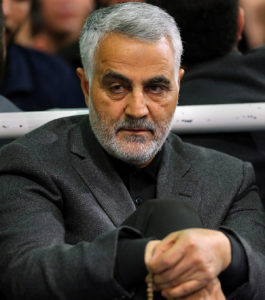
Qassim Suleimani photo from Wikimedia Commons
Qassim Suleimani (photo via Wikimedia Commons)

One overlooked aspect of the apparently impulsive and reckless decision to kill Qassim Suleimani: how evil is enabled by bureaucracy.

In this case, according to reporting, Trump’s advisers presented him with “bracketed options,” a common bureaucratic tactic. Bracketed options are designed to manipulate the recipient into choosing what the presenters want.

It’s a Goldilocks process: offer one choice that’s too far one way, another that’s too far the other way, and one in the middle that’s “just right.”

The trouble this time: these bureaucrats were dealing with Trump, who thinks at the level of an emotionally disturbed child. And he chose the most extreme option. He wasn’t supposed to, it was only there to nudge him towards another one, but he chose it.

It’s not that Suleimani didn’t have it coming. He was a brutal terrorist who could be targeted under the standards of just war, depending on the circumstances. But Trump appears to have risked chaos — death and suffering for untold numbers of people — with little more than a moment’s thought. If so, even if it somehow works out, this will still have been a grotesquely irresponsible decision.

“Top Pentagon officials were stunned,” according to the New York Times.

First of all, how could they possibly be stunned? Did they forget it was Donald Trump they were dealing with? An incredible lack of foresight for people we trust to plan wars.

But also, this was a typical example of bureaucratic dishonesty — one that happened to backfire terribly — found throughout government and in the private and nonprofit sectors too: anywhere that people are incentivized to diffuse accountability while their self-interest remains concentrated. Note that as stunned as Trump’s advisers were, none was too stunned to stick with the program — or lack of program, in this case.

Not every bureaucrat is dishonest, of course. Some are positively noble, like the courageous impeachment investigation witnesses who have risked their careers, and even their personal safety, in the service of truth and duty. And many just quietly and anonymously do their best.

But the incentives of bureaucracy encourage the ignoble. Stand up for the right thing and risk your livelihood? Or keep your head down and try to work the system?

Under these conditions, too often it’s the worst people who rise to the top: those who are the most skilled at pursuing their own interests while hiding them, behind a deliberately bland countenance.

This studied boringness can an asset, since it deflects attention from what’s really up. Attorney General William Barr is an exemplar. Watch any of his public defenses of the indefensible. Words, tone, body language: all say, “Nothing to see here.”

But we may not need a Barr. Evil can happen passively, just because it’s allowed to happen, just because no one is on the hook.

Either way, much of the evil done in our world has no apparent evil-doer. It seems to be born from the void, and so it is.

The void may be the absence of accountability, or it may be the void at the core of a deliberate schemer like the nihilistic Barr. When asked recently if he worries about the damage he’s done to his reputation, he answered, “Everyone dies.”

As Hannah Arendt says in “On Violence,” “The greater the bureaucratization of public life, the greater will be the attraction of violence… for the rule by Nobody is not no-rule, and where all are equally powerless we have a tyranny without a tyrant.”

Filed Under: Leadership & Management, Politics & Society Tagged With: bureaucracy, iran, qassim suleimani, trump, war

  • « Go to Previous Page
  • Page 1
  • Interim pages omitted …
  • Page 4
  • Page 5
  • Page 6

Primary Sidebar

Search This Site

Broadcast Appearances

Spencer Critchley on Spectrum News 1 LA

Book

Patriots of Two Nations by Spencer Critchley
Kindle & paperback at Amazon. Audio book at Audible. EPUB format here.

New Music: Jailbreak

Cover image for the song "Jailbreak:" a ruined motel by the side of a lonely desert road.

Podcast

Dastardly Cleverness in the Service of Good

Social Media

Substack

YouTube

Music: The Critchleys

The Critchleys: Owen and Spencer Critchley

About Me

Spencer Critchley

Jump to Recent Posts

New Music: The Desert Mothers

The True Crisis

Outside in the Rain

The Liberal Backbone

Slowly and then all at once

On the Podcast: A Letter to a Friend Voting for Trump

“The War of the Worldviews” at TedX Pugwash

Recent Comments

  • terry rankin on “The War of the Worldviews” at TedX Pugwash
  • Spencer Critchley on Why Biden was right to link MAGA, the Confederacy & the Axis in his SOTU address
  • Spencer Critchley on Why Biden was right to link MAGA, the Confederacy & the Axis in his SOTU address
  • Scott Sexton on Why Biden was right to link MAGA, the Confederacy & the Axis in his SOTU address
  • Anonymous on Why Biden was right to link MAGA, the Confederacy & the Axis in his SOTU address

Photos

Spencer Critchley on Fox News' Cavuto
Barack Obama photo by Spencer Critchley
Bruce Springsteen photo by Spencer Critchley
Jay-Z photo by Spencer Critchley
Tiny American flag in crowd at political rally
Director Elizabeth Thompson & Composer/Audio Producer Spencer Critchley with the Emmy for the PBS documentary "Blink."

Find more photos here.

Privacy Policy

Learn how this site collects information and how you can control that.

© 2005–2026 Spencer Critchley