• Skip to primary navigation
  • Skip to main content
  • Skip to primary sidebar

Spencer Critchley

  • Home
  • About
  • Media Appearances
    • Broadcast Appearances
    • Print & Web Coverage
    • My Reporting & Commentary
    • Podcast
    • “Saving Democracy” Events
    • News: Real or Fake?
    • Hallmarks of a #BadArgument
  • Music
  • Photos
  • Subscribe
  • Contact

trump

We’re Watching Trump’s Presidency Implode

October 8, 2020 by Spencer Critchley

I was on a panel on China Global Television Network’s “The Heat” on Oct. 7, 2020, talking with host Mike Walter about President Trump’s return to the White House after his hospital treatment for COVID-19, in the context of my book Patriots of Two Nations.

Excerpt:

Spencer Critchley: I think he’s in very serious trouble, and we’re watching his presidency imploding before our eyes, and we’re watching his behavior become increasingly frantic as he tries to figure out what story he could possibly spin to get himself out of this trouble, which is really his only tactic, as essentially a lifelong con man. And, I would say, a very seriously damaged human being.

I actually feel some compassion for him, wondering what the pain must have been like of his childhood, to turn him into a person who’s grown up to be apparently incapable of imagining the lives of others and seeing everything as a projection of himself.

I think this is also, as terrible as it is, if I could be forgiven for using the word, it’s the perfect crisis for his presidency because, as I found in researching my book, the division we’re experiencing now didn’t start with Trump, and in fact, it goes all the way back to the founding of the country. And he really represents a worldview that’s different from the Founders’ worldview. But it’s one that’s always been there, and it’s one that actually rejects the Enlightenment legacy of reason in favor of faith, tradition, loyalty to the leader, ties to the native land, and ethnic identity.

And I think that’s one reason why it feels like we’re living in different realities when we talk to Trump supporters. But what’s happening now is Trump’s reality is actually colliding with the reality that kills more more than 210,000 Americans, or destroys our reputation, or blows up the economy. It has these real world impacts that cannot, as I say, be spun away with a story.

Mike Walter: And does that shatter that — that kind of mythology for his followers?

Spencer Critchley: Yes, I would have predicted, and I do predict this in the book. I describe what would shake this absolute loyalty of his followers, which we should think of, I would say, in pre-Enlightenment terms, as if we’re in the Middle Ages or the Dark ages. If you imagine knights, loyal to their king on the battlefield, and nothing will shake their oath of loyalty because his authority is embodied in him — except failure, and that’s what we’re seeing here.

Filed Under: Politics & Society Tagged With: coronavirus, COVID-19, election2020, trump

From Lincoln-Douglas to Trump-Biden: Progress Is Not Inevitable

October 1, 2020 by Spencer Critchley

Professional wrestlers in the ring
Photo: iStock

I hadn’t realized I could watch an American political event and feel grief — and humiliation.

Progress is not inevitable. We have to earn it. This mess happened because we allowed it to happen. Through our negligent distraction, we created a society in which an emotionally disturbed child could become president. Our civic discourse has devolved from the Lincoln-Douglas debates to what might as well be pro wrestling. (I talked about this on Fox News’ Oct. 2, 2020 edition of “Your World with Neil Cavuto.”)

I predicted the debate would be bad, and in the way it was. And even still, I wasn’t prepared for how bad it was. Below is what I wrote on social media — and if you think I’m exaggerating about attention spans, consider this: one of Facebook’s top metrics for ad success is how many people watch a video for three seconds.

The conservative icon William F. Buckley said, “Never debate with an amateur” — they’ll just yell whatever they want and you’ll get lost — and you’ll lose — in the chaos.

This may be the biggest risk that Joe Biden faces in the debate: Trump generating endless sound and fury, signifying nothing, and thereby dragging Biden into the void.

The risk is made much greater if Biden tries to develop arguments that require more than a short phrase to state: Trump will ensure no one can hear the middle, let alone the finish.

Biden should aim for perfecting the first second of his answer — after that second, attention spans fall off rapidly, and are largely gone between the 5 and 10-second marks.

It’s a sorry place to find ourselves, considering the debate format was handed down to us by Socrates. But it’s where we are. Trump knows it — and furthermore, as someone with no attention span himself, he’s in his element.

Filed Under: Politics & Society Tagged With: election2020, politics, trump

Replacing RBG: Why the Hypocrisy Doesn’t Matter to Trump’s Base

September 21, 2020 by Spencer Critchley

In pre-Trump days, the beyond-brazen hypocrisy of Mitch McConnell, Lindsey Graham and most other Republicans in Congress would have caused grave damage to their reputations. We’ve always had hypocrisy, of course, but it used to be that people were embarrassed to be caught at it.

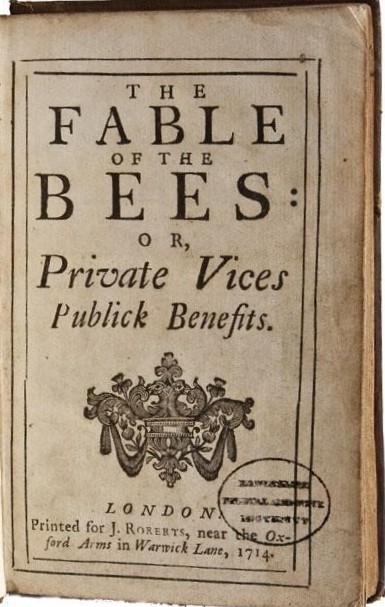
The fable of the Bees, by Bernard Mendeville
Image via Wikimedia Commons

But now, there’s no need even to waste time trying to cover it up. To Trump’s most committed base, hypocrisy doesn’t matter.

Trump’s opponents are tempted to conclude that such people must be either stupid or evil. What they miss is that Trump’s base lives within a different world view, one that rejects the Enlightenment standard of reason on which our democracy was founded. As I show in Patriots of Two Nations, this Counter-Enlightenment world view also dates to the Founding, but it rejects the primacy of reason in favor of faith, tradition, ethnicity — and loyalty to the leader. Throughout most of our history it was obscured by the dominant Enlightenment world view. But under Trump, it’s resurgent.

In this world view, Trump is the instrument of God’s will and the nation’s destiny. By comparison, consistency in what he or his supporters say hardly matters. Consistency, as Emerson (a Counter-Enlightenment figure) said, is “the hobgoblin of little minds:”

A foolish consistency is the hobgoblin of little minds, adored by little statesmen and philosophers and divines. With consistency a great soul has simply nothing to do. He may as well concern himself with his shadow on the wall. Speak what you think now in hard words, and to-morrow speak what to-morrow thinks in hard words again, though it contradict every thing you said to-day. (Ralph Waldo Emerson, Self-Reliance.)

This does not necessarily mean, though, that McConnell, Graham and the rest are driven by a mystical, Counter-Enlightenment creed. No, I’m pretty sure they’re classical hypocrites, driven only by the desire to acquire and defend power. They exploit people who believe in things.

The most charitable interpretation of such behavior is that they adhere to Bernard Mandeville’s argument in The Fable of the Bees (1714) that “private vices” yield “public benefit,” i.e. that the pursuit of self-interest produces prosperity for all. It’s an idea that underlies the laissez-faire economics developed by Adam Smith and enacted every day in modern free market economies.

Except, as Smith emphasized, self-interest must operate within conditions of justice, or else it turns into mere predation:

How selfish soever man may be supposed, there are evidently some principles in his nature, which interest him in the fortune of others, and render their happiness necessary to him, though he derives nothing from it except the pleasure of seeing it. (Adam Smith, The Theory of Moral Sentiments.)

The trouble is, some of us, such as our current president and his enablers, appear to feel nothing of such pleasure.

Filed Under: Politics & Society Tagged With: politics, rbg, ruth bader ginsburg, supreme court, trump

Trump and the Lure—for All of Us—of Evil for Its Own Sake

September 20, 2020 by Spencer Critchley

Some of the attraction to Trump is based on a desire to indulge in evil for its own sake: for the sheer, dark pleasure of releasing humanity’s ugliest urges — and that’s a desire that’s not found only in Trump supporters but in all of us. I got a chance to go into this in depth with Dean Walker, the host of an original and thoughtful video podcast called The Poetry of Predicament. Here’s an excerpt (starting at 27:56), with a transcript:

In the book [Patriots of Two Nations] I talk about the difference between Marx and Freud as a dichotomy that expresses that [the Jungian shadow self] and you can extend that from Freud to Jung. So Marx thought he had discovered the science of history. This is interesting, because this is one of the roots of intolerance on our side of the political spectrum, of liberals, that we often overlook. We overlook this shadow side of ourselves, that there is a form of liberal intolerance and even authoritarianism that we often think we don’t have — that’s the other side that’s like that. We’re all about community, you know, and helping each other, and looking after the vulnerable, etc. But there is a form of liberal intolerance that’s very serious and can get quite, well, extremely dark.

And I think the roots are in the Enlightenment gone mad. There are situations in history where the Enlightenment has gone mad and when the Counter-Enlightenment has gone mad. The Enlightenment gone mad is when you’re hyper-rational and you think rationality explains everything. And Marx thought he had discovered the science of history. This was a trend in German philosophy at the time. And if you think you’ve discovered the science of history and therefore, you know, the science of politics and how government should be organized, you’re on the road to deep intolerance, because anybody who disagrees with you is either wrong or corrupt, right? Those are the only choices. So they have to either be reeducated or stopped, you know, probably through punishment, possibly through death.

And the results of how people interpreted what Marx was saying — Marx, by the way, was also quite an anti-semite, I’m afraid it was quite common back then — but the results are things like the Marxist-Leninist dictatorship in the Soviet Union and the other countries, like Maoist China and Cambodia, and other countries that followed suit, where, in the interests of a theory of how society was supposed to work, horrible crimes were committed and unspeakable cruelties. In the Soviet Union, tens of millions of peasants died and lot of that was because, starting with Lenin, they were trying to convert real-world Russian peasants into theoretical Marxist-Leninist proletarians and people literally died or were imprisoned or tortured in service of that hyper-rationalist, soulless, heartless ideal.

The Counter-Enlightenment gone mad is Nazism, which is an extremely hyper-romantic vision of national destiny descended from what Wagner was talking about. Wagner, in the Ring Cycle, was attempting to express the soul of Germany, of the German people. And it begins with the Rhinemaidens as an image of perfect innocence and joy, guarding the Rheingold, which is the gold of the nation of Germany and is the essential goodness and wealth and power of the German people. And what are they threatened by? The evil dwarf Alberich, who’s a stereotypical Jew. We see that strand throughout history, down to the present day in the United States, with the bigotry we see in the United States, and people talking about Make America Great Again, which is descended straight from that vision of a pure state of national greatness that has to be recovered.

But as you can see, there is just a great deal of darkness waiting there to be tapped. And I mentioned when I launched into this the dichotomy of Marx versus Freud. So Marx is hyper-rationalist, in my view, and his terrible mistake was thinking he had discovered a science of history. Freud came along later. I often wonder what would have happened if Marks had lived a little later and had met Freud, and would it have caused him to rethink things?

Because Marx was also extremely naive about human nature. He thought that the reason people did bad things was because of private property. And if we just removed private property — and there are many liberals who still feel this way, this idea has not gone away — if we only didn’t have capitalism and private property, people wouldn’t be greedy and heartless and cruel to each other. That’s an extremely naive view of human nature, in my view. And in fact, it’s no more sophisticated or aware than any religious viewpoint. It is essentially, I would say, a religious statement of belief, not founded on any understanding of how human beings actually work. And Freud thought Marx was naive.

Freud understood — although he wasn’t right about everything by any means, but he at least intuitively understood — that we have these competing drives towards life and death: Eros and Thanatos. He didn’t use that word, but referring to the death drive, which is the way he described it, there’s something in us that just wants to destroy and hate just for the sheer pleasure of it. And I think Freud was a lot closer to the truth. These horrible things we’ve seen in world history and in American history, with slavery, these awful things we can point to down to the present day, with locking up little Children in cages on the border.

I think that’s what we have to understand, that that’s in us. And the extent to which we think we understand that problem by saying there’s something evil about Trump supporters, for example, or there’s something evil about Trump himself, I think we’re missing the point. There’s something evil in human nature — if we want to use that word, “evil” — that we need to turn towards and recognize and understand, because if we keep casting it out of ourselves and saying it’s only in those other people, we’re just going to keep repeating this cycle.

Filed Under: Politics & Society Tagged With: evil, freud, marx, trump

How Liberals Left a Gap for Con Artists Like Trump to Fill

September 17, 2020 by Spencer Critchley

I had a great, hour-long conversation with host Joan Esposito on WCPT-AM Chicago on Tuesday, Sept. 15, 2020. Here’s an excerpt, about the gap we left for con artists like Trump to fill (transcript below). You can listen to the full interview on Soundcloud.

[00:00:00] Spencer Critchley: We, I would say, as Enlightenment rationalists, which includes most liberals but also moderate conservatives — basically anybody who believes in rationality — have left an opening for unprincipled people like Alex Jones or like President Trump to exploit. The great German sociologist Max Weber — I mentioned him a couple of times in the book as well — referred to the “disenchantment” of the world in a lecture called “Science as a Vocation,” that he gave in 1917.

And what he meant by that was that the Enlightenment had taken away a lot of the enchantment and mystery and depth and meaning from the world and left us with logic and facts. And that’s part of this problem, that because liberals are descended from the Enlightenment and believe in science and rationality, those are obviously strengths, but it can also come across as spiritually and aesthetically empty. And that leaves this gap, this hunger, that I think — basically, we all have to find a deeper meaning in life than just the numbers, just the data, right, which, as I said earlier, is why we listen to music, and [we] like art and poetry, or are attracted to cultures that seem to still maintain some kind of connection to nature and tradition.

And the trouble is by not filling that need, by being overly rational, we’ve left it open for exploitation by demagogues like Trump or by dishonest media outlets. And those media outlets have been greatly enabled by the rise of technology because it used to be, there were only a few major television networks and print publications, and now we have hundreds and hundreds of TV channels and an infinite number, in effect, of Internet channels, which has enabled any dishonest or insane person to spread whatever fantasies or lies they care to. But part of the responsibility for that, I would say, is that by becoming too much stuck in our heads, we’ve left a gap there that’s going to be filled by somebody, and sometimes it’s filled by poets and artists, or genuinely well meaning spiritual leaders. But sometimes it’s filled by con artists and that’s part of what we’re seeing now.

[00:02:23] Joan Esposito: Is part of what you’re talking about — I remember when I was a little girl and I was raised Catholic, and there was a time when the masses were said in Latin, And then there was a change and the mass was going to be said in English. And I can remember people being upset by that because they said that when they understood the words, somehow some of the magic of the mass had gone away for them. And I always found that incredibly puzzling — so when it was Latin, sort of mumbo jumbo, there was a higher spiritual feeling that they got. And when they knew what the words actually meant and what was actually being said — it sounds a little bit like that. Like what you’re talking about.

[00:03:13] Spencer Critchley: Yeah. I mean, if you think about the King James Bible, for example, versus the modern, idiomatic translations of the Bible, which are written in modern American English, some of them, I actually prefer the King James version of the Bible because I feel that the rhythm of the poetry just works much better. It just works better as poetry. It doesn’t make any sense, but poetry doesn’t make much sense, and this gets to how language is used.

Language can be used to make logical propositions, and we can analyze whether the premises are factual and then we can analyze whether the logic is sound. But language is also used to write poetry or songs or liturgies in the various world religions. And one way of picturing the divide I’m talking about is, imagine walking into a Catholic church service or a mosque or Jewish temple or any religious service and yelling out, “There is no scientific evidence that any of this stuff is true!” I think it’s pretty easy to see that that’s certainly defensible from a scientific point of view. But it would be a very inappropriate use of language, and you’d kind of be missing the point because those folks, they’re not in there talking science. They’re pursuing some higher form of truth.

Now, your caller would probably argue, well, there is no higher form of truth; they’re fooling themselves. But they don’t believe that, and they feel that they’re experiencing this higher form of truth by gathering together and by repeating these words and listening to this music in a way that is non-rational. And you know most of them, I think, or at least many of them, are very much aware it’s not rational, but in the same way we’re all aware that if we’re reading the poetry of William Blake, for example, we don’t expect it to be rational.

And in fact, you know, William Blake was a Counter-Enlightenment figure, very aggressively Counter-Enlightenment. He hated the Enlightenment. He thought it was the death of the soul, like most of the other romantic poets. So there is something there that I think we need to recognize. It doesn’t mean we need to agree with people we’re arguing with, but we need to understand how they could be seeing the world so differently and how even language could be used differently.

So coming at somebody with facts and logic, this kind of explains that crazy-making experience when we say, “Look at the number of times President Trump has demonstrably lied,” for example, “and here’s the proof!” And it doesn’t seem to make any difference. Well, there are other uses of language, and his followers would probably argue that facts and logic are a pretty small form of truth compared to the higher truths that they’re pursuing.

[00:05:52] Joan Esposito: We have so many people who want to join our conversation. The phone lines have lit up. So, Spencer, please, please, hang on. Please stay with us. Wonderful. We have a lot to talk about. I’m talking with Spencer Critchley. The book is called Patriots of two Nations, about the divide that has existed as long as we have been a country. We will continue this discussion right after this.

Filed Under: Politics & Society Tagged With: trump

  • « Go to Previous Page
  • Page 1
  • Interim pages omitted …
  • Page 3
  • Page 4
  • Page 5
  • Page 6
  • Go to Next Page »

Primary Sidebar

Search This Site

Broadcast Appearances

Spencer Critchley on Spectrum News 1 LA

Book

Patriots of Two Nations by Spencer Critchley
Kindle & paperback at Amazon. Audio book at Audible. EPUB format here.

New Music: Jailbreak

Cover image for the song "Jailbreak:" a ruined motel by the side of a lonely desert road.

Podcast

Dastardly Cleverness in the Service of Good

Social Media

Substack

YouTube

Music: The Critchleys

The Critchleys: Owen and Spencer Critchley

About Me

Spencer Critchley

Jump to Recent Posts

New Music: The Desert Mothers

The True Crisis

Outside in the Rain

The Liberal Backbone

Slowly and then all at once

On the Podcast: A Letter to a Friend Voting for Trump

“The War of the Worldviews” at TedX Pugwash

Recent Comments

  • terry rankin on “The War of the Worldviews” at TedX Pugwash
  • Spencer Critchley on Why Biden was right to link MAGA, the Confederacy & the Axis in his SOTU address
  • Spencer Critchley on Why Biden was right to link MAGA, the Confederacy & the Axis in his SOTU address
  • Scott Sexton on Why Biden was right to link MAGA, the Confederacy & the Axis in his SOTU address
  • Anonymous on Why Biden was right to link MAGA, the Confederacy & the Axis in his SOTU address

Photos

Spencer Critchley on Fox News' Cavuto
Barack Obama photo by Spencer Critchley
Bruce Springsteen photo by Spencer Critchley
Jay-Z photo by Spencer Critchley
Tiny American flag in crowd at political rally
Director Elizabeth Thompson & Composer/Audio Producer Spencer Critchley with the Emmy for the PBS documentary "Blink."

Find more photos here.

Privacy Policy

Learn how this site collects information and how you can control that.

© 2005–2026 Spencer Critchley