• Skip to primary navigation
  • Skip to main content
  • Skip to primary sidebar

Spencer Critchley

  • Home
  • About
  • Media Appearances
    • Broadcast Appearances
    • Print & Web Coverage
    • My Reporting & Commentary
    • Podcast
    • “Saving Democracy” Events
    • News: Real or Fake?
    • Hallmarks of a #BadArgument
  • Music
  • Photos
  • Subscribe
  • Contact

Politics & Society

A letter to a friend who voted for Trump

November 13, 2016 by Spencer Critchley

Also published at Huffington Post.

Dear _____________,

We wouldn’t be friends if we didn’t see the best in each other.

It’s because of that that I need you to help me understand what you just did.

I know you’re not a bigot. If we disagree on some social policy question, it’s never because we disagree about equality, only about the best way to achieve it.

But you just voted for a bigot. Please don’t tell me he isn’t one. Ask any black, brown, or Muslim friends or colleagues you have how they feel about Trump’s five years of promoting the racist birther lie, founding his campaign on the false claim that Mexican immigrants are a threat (you do know they have a lower crime rate than native-born Americans, right?), pledging to ban all Muslims (lower-than-average crime rate there, too), or aligning with white nationalism?

If they learn you voted for Trump, they may never look at you quite the same way again. Can you tell them that you did?

If so, how?

Read more in The Huffington Post…

Filed Under: Politics & Society Tagged With: Donald Trump, presidential election 2016

The Only Argument for Trump Is Wrong: He’s Not a Success, He Just Plays One on TV

October 30, 2016 by Spencer Critchley

[Also published at Huffington Post.] It shouldn’t need saying, but not all of Donald Trump’s supporters are bigoted, misogynistic idiots.

Many support him despite his hateful, simplistic campaign and his glaring character flaws, for one reason that they think Trumps everything:

Washington is broken. Who better to fix it than a highly successful outsider?

You probably know people who think this. If so, please share this crucial information:

Donald Trump is not a success. He only plays one on TV.

Consider the facts, not the flash.

  1. Trump was “a stock market disaster,” as CBS Marketwatch columnist Brett Arends has documented:
Charts of poor Trump business results vs. S&P 500
Brett Arends, CBS Marketwatch (Data: Factset)

Somehow, Donald Trump managed to blow a lot of money running casinos. Arends notes:

Over the same period, investors in competitor Harrah’s Entertainment more than doubled their money. Investors in luxury hotel, casino and resort companies like Starwood and MGM earned returns of more than 400%. Even the plain old stock market index more than doubled.

  1. In fact, as the National Journal’s S.V. Dáte showed last year, over his adult life Trump could have made about as much or more money – and caused less damage from bankruptcies and his habitual stiffing of creditors – if he’d put the money he inherited from his father into an index fund and left it alone. Dáte’s numbers are necessarily imprecise and the details can be argued, but the point stands: Trump’s performance as an entrepreneur, as opposed to a lucky rich kid, is unimpressive. Just ask a real success, Warren Buffett:

“People who believed in [Trump], who listened to his siren song, came away losing well over 90 cents on the dollar. They got back less than a dime,” Buffett said at a rally for Hillary Clinton Monday. “In 1995, when he offered this company, if a monkey had thrown a dart at the stock page, the monkey on average would have made 150%.”

  1. In 1995, as the New York Times first reported, Trump reported a loss of nearly a billion dollars – a billion dollars! – and apparently used it to avoid paying federal taxes for up to 18 years. “That makes me smart,” he brags, about a gigantic collapse that left his investors holding the bag.
  2. A partial list of Trump’s failures includes the casinos, Trump Shuttle, Trump Vodka, Trump magazine, Trump World magazine, and Trump University – the last facing multiple investigations and lawsuits alleging it was “really a fraud from beginning to end,” in the words of New York State Attorney General Eric Schneiderman.
  3. As Ivanka Trump recounted in the 2003 documentary “Born Rich,” her father once told her he was billions in debt:

I remember once my father and I were walking down Fifth Avenue and there was a homeless person sitting right outside of Trump Tower… it was around the same time as the divorce. And I remember my father pointing to him and saying, “You know that guy has 8 billion dollars more than me.” Because he was in such extreme debt at that point.

Ivanka said she was proud of the way her father came back from that. But consider how he did it…

  1. Since flopping as a developer and investor, Trump has dropped those pursuits, and switched to a new one: licensing his brand. In other words, he’s been selling the gilded image of himself as a success, long after the reality failed — and while his branded properties continue to fail.

This is the character he’s been playing since the 2004 debut of “The Apprentice.” Unfortunately, even some well-meaning people have been fooled into thinking that character is real.

Ironically, it’s through the pretend Trump that the actual Trump finally has succeeded — and on his own “merits,” too:

At long last, he really is making money — out of being a phony.

Filed Under: Politics & Society Tagged With: Donald Trump

As ‘Brand’ Replaces Reputation, Democracy Goes to Hell

October 16, 2016 by Spencer Critchley

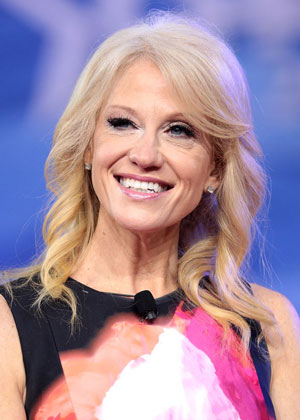
Kellyanne Conway
Kellyanne Conway photo by Gage Skidmore via Wikimedia Commons

[Also published at Huffington Post.] There’s one question that has so far gone unasked during any of the thousands of interviews with Donald Trump’s surrogates or spokespeople, but during each one, it’s the elephant in the room:

What is wrong with you?

How can any educated, rational, moral person be willing to lie so flagrantly, on behalf of a grotesquely unworthy candidate for the most important job in the world?

The question goes unasked, of course, because it would violate the norms of civil discourse, on which democracy depends.

The trouble is, Trumpists are happy to violate those norms, knowing they have their interlocutors in a bind: Responsible journalists can only respond with the facts. But if you don’t care about facts — if you deny them when they’re played for you on video — there’s nothing to constrain you from saying anything.

As Josh Barro tweeted recently, “Trump’s people lie and lie and lie and lie and lie and they don’t even respect us enough to lie well.” 

How did we get here? We’ve always had dishonesty in politics, but how did we get to this point of utter shamelessness?

KellyAnne Conway, Jason Miller, Rudy Giuliani, Newt Gingrich, and the rest all appear to be rational people. They have to know that they will carry the stink of this campaign for the rest of their lives. Whether Trump loses or (incredibly) wins, their reputations are destroyed.

Ah. That’s it. Reputations don’t matter any more.

We’ve replaced them with “brands.”

And nothing destroys a brand, as long as it keeps selling.

Newt Gingrich, for example, didn’t need the Trump campaign’s help to destroy his reputation. He long since did that himself. And yet he still gets booked all over cable TV, still gets paid to speak, still runs profitable scams.

His brand still sells.

When reputation mattered, it was a brake on perfidy. The fear of public shaming would cause even the most mendacious public figures to modulate their behavior.

Now, shame is a monetizable commodity: just ask any celebrity who’s traveled the well-worn circuit of fame — humiliation — more fame.

You can’t threaten a Trumpist with shame, because they’re wearing the reputational equivalent of suicide vests. Just like terrorists believe they’ll live on in paradise, Conway, Gingrich, and the rest believe — with reason — they’ll live on in media.

We sophisticated moderns may be rediscovering, through its absence, the value of the archaic concept of honor. To the signers of the Declaration of Independence, honor was “sacred.” To us, it seems quaint.

But what if we brought it back? Not exactly the old version, which was often tied to assumptions about class, gender, race, and censorship that we’ve rightly left behind, but one rooted in a basic reverence for democracy?

Journalists often say of KellyAnne Conway that, despite the flagrant dishonesty, she’s “a professional,” or a “good person.” I understand the desire to preserve standards of civil discourse. But Conway and her colleagues are exploiting those standards, and in so doing they’re undermining democracy.

They’re behaving dishonorably. Even in — or especially in — the most democratic society, there should be a cost for that.

Filed Under: Leadership & Management, Politics & Society Tagged With: branding, Donald Trump, marketing

I know it sounds insane, but Trump sure looks like a Russian agent

October 10, 2016 by Spencer Critchley

Vladimir Putin
Vladimir Putin photo from Wikimedia Commons

[Also published at Huffington Post.] One of the foundational ideas of artificial intelligence is the Turing Test, named for the brilliant Briton Alan Turing. According to the Test, if a computer can act enough like a human mind to fool an actual human, the computer can be said to have achieved human intelligence.

If we adapt the Turing Test for Russian agents, Donald Trump passes.

We don’t have direct knowledge that Trump is in fact a Russian agent, for now at least. But he acts so much like one that it’s impossible to tell the difference.

I know how crazy this sounds, and believe me, I am no fan of conspiracy theories. But the evidence keeps piling up.

At Monday night’s debate, Trump once again defended Russia against charges that it’s interfering in our election, like he did in the first debate, and at other times. In so doing, he argues against his own country’s intelligence services, which have unequivocally stated — including in briefings to Trump — that Russia is behind the hacking and disinformation we’ve been facing.

Trump defends Russia against criticism whenever he has the chance. He also frequently praises its dictatorial president, Vladimir Putin — a man who jails and kills political opponents — as a stronger leader than the democratically elected Barack Obama.

Until it became too awkward, Trump’s campaign manager was Paul Manafort, who enriched himself by consulting for the former Ukrainian prime minister, and Putin puppet, Viktor Yanukovych. While Manafort was still in charge of the Trump campaign, it removed a plank from the Republican platform that had called for arming the new Ukrainian government against Russian incursions.

Trump has also on the one hand denied that Russia has gone into Ukraine (to be fair, this might just have been stupidity), and on the other suggested the annexation of Crimea (part of Ukraine) might have been justified.

Trump’s position on NATO — that the U.S. shouldn’t protect allies unless they pay — might as well be custom-designed to advance Putin’s dream of weakening the alliance that has protected the West since World War II.

Trump has pursued and profited from multiple business dealings in Russia. According to comments by Donald Trump, Jr. in 2008: “Russians make up a pretty disproportionate cross-section of a lot of our assets. We see a lot of money pouring in from Russia.”

And now there’s this: Newsweek reporter Kurt Eichenwald has noticed that the Russian government appears to be feeding disinformation directly to Trump. At a rally today in Wilkes Barre, Pennsylvania, Trump read from a document that purports to prove a connection between Hillary Clinton and supposed perfidy in Benghazi, via an email Trump claimed was written by Clinton friend Sidney Blumenthal.

“He’s now admitting they could have done something about Benghazi,’’ Trump said, dropping the document to the floor. “This just came out a little while ago.”

The crowd booed and chanted, “Lock her up!”

The trouble is, Eichenwald knows the email is a fake, because it uses language misleadingly lifted from one of Eichenwald’s own Newsweek articles, in a form only ever published by the Russian government propaganda organ Sputnik:

This is not funny. It is terrifying. The Russians engage in a sloppy disinformation effort and, before the day is out, the Republican nominee for president is standing on a stage reciting the manufactured story as truth. How did this happen? Who in the Trump campaign was feeding him falsehoods straight from the Kremlin? (The Trump campaign did not respond to a request for comment).

The Russians have been obtaining American emails and now are presenting complete misrepresentations of them—falsifying them—in hopes of setting off a cascade of events that might change the outcome of the presidential election. The big question, of course, is why are the Russians working so hard to damage Clinton and, in the process, aid Donald Trump?

An agent is someone who acts on behalf of another. Possibly it’s unwitting, as so much of his behavior seems to be, but by his own words and deeds, Donald Trump is indistinguishable from an agent for Vladimir Putin‘s Russian Federation.

Filed Under: Politics & Society Tagged With: Donald Trump

Calling it: Trump is going to quit, citing impact on family

October 8, 2016 by Spencer Critchley

There should be a word that combines “absurdly” and “tragically” — “absurgically?” It’s hard to be more absurgically wrong than I was when I wrote this:

[Also published at Huffington Post.] If only because Donald Trump says there’s a “zero percent” chance he’ll do it, I’d expect him to drop out of the presidential race. Since about three-quarters of what he says has been shown to be false, it’s a pretty good bet even blindfolded.

But in plain sight are other, more substantive reasons:

  • Party leaders desperately wish they could fire him, but can’t. His quitting is their only out.
  • He’s a raging narcissist, facing one of the most crushing humiliations in American history. He won’t be able to see that through.
  • Despite his pose as the ultimate winner, he frequently fails. And when he does, he always blames others.
  • And finally, showing concern for his family — especially a daughter he has leered overand a wife he has boasted of betraying — may at this point be the only sympathetic move he can possibly make.


Filed Under: Politics & Society

  • « Go to Previous Page
  • Page 1
  • Interim pages omitted …
  • Page 22
  • Page 23
  • Page 24
  • Page 25
  • Page 26
  • Interim pages omitted …
  • Page 34
  • Go to Next Page »

Primary Sidebar

Search This Site

Broadcast Appearances

Spencer Critchley on Spectrum News 1 LA

Book

Patriots of Two Nations by Spencer Critchley
Kindle & paperback at Amazon. Audio book at Audible. EPUB format here.

New Music: Jailbreak

Cover image for the song "Jailbreak:" a ruined motel by the side of a lonely desert road.

Podcast

Dastardly Cleverness in the Service of Good

Social Media

Substack

YouTube

Music: The Critchleys

The Critchleys: Owen and Spencer Critchley

About Me

Spencer Critchley

Jump to Recent Posts

New Music: The Desert Mothers

The True Crisis

Outside in the Rain

The Liberal Backbone

Slowly and then all at once

On the Podcast: A Letter to a Friend Voting for Trump

“The War of the Worldviews” at TedX Pugwash

Recent Comments

  • terry rankin on “The War of the Worldviews” at TedX Pugwash
  • Spencer Critchley on Why Biden was right to link MAGA, the Confederacy & the Axis in his SOTU address
  • Spencer Critchley on Why Biden was right to link MAGA, the Confederacy & the Axis in his SOTU address
  • Scott Sexton on Why Biden was right to link MAGA, the Confederacy & the Axis in his SOTU address
  • Anonymous on Why Biden was right to link MAGA, the Confederacy & the Axis in his SOTU address

Photos

Spencer Critchley on Fox News' Cavuto
Barack Obama photo by Spencer Critchley
Bruce Springsteen photo by Spencer Critchley
Jay-Z photo by Spencer Critchley
Tiny American flag in crowd at political rally
Director Elizabeth Thompson & Composer/Audio Producer Spencer Critchley with the Emmy for the PBS documentary "Blink."

Find more photos here.

Privacy Policy

Learn how this site collects information and how you can control that.

© 2005–2026 Spencer Critchley