• Skip to primary navigation
  • Skip to main content
  • Skip to primary sidebar

Spencer Critchley

  • Home
  • About
  • Media Appearances
    • Broadcast Appearances
    • Print & Web Coverage
    • My Reporting & Commentary
    • Podcast
    • “Saving Democracy” Events
    • News: Real or Fake?
    • Hallmarks of a #BadArgument
  • Music
  • Photos
  • Subscribe
  • Contact

Communication

On the Right, Symbols of Anything and Nothing

February 28, 2021 by Spencer Critchley

The Golden Trump idol, beating cops with a Blue Lives Matter flag, Kayleigh’s cross… I’m thinking today about how the right’s flight from reason towards faith has overshot the mark so far that the symbols they use no longer have any consistent meaning whatsoever.

Silver crucifix necklace worn on a black sweater.
iStock

Communicating in symbols, such as the symbols of religion or art, can be a way to express truths that reason can’t. But on the Trumpian right, symbols now appear to be the whole point: they don’t have to mean anything in particular, beyond what you want them to mean in the moment. That is the new freedom.

The Golden Trump presented for veneration at CPAC — with some fans literally bowing before it — could hardly be more blasphemous in the context of a Christianity whose symbols used to have meanings. God literally told his people never to make golden idols, on pain of obliteration.
Then there’s the American flag, which previously flew as a symbol of freedom, now repurposed as shorts cradling the junk of a would-be dictator.

Since a flag is now meaningless beyond whatever one wants it to mean in the moment, the Stars and Stripes can be torn from the Capitol by “patriots.” A Blue Lives Matter flag can be a weapon against blue lives, because law and order means rioting when you want it to.

Not long ago Kayleigh McEnany’s little gold cross was a symbol of eternal faith, morality, and truth — Jesus was the word of God made flesh. By wearing a cross while working as a professional and enthusiastic liar in the service of a dishonest and immoral Caesar, Kayleigh staged a symbolic crucifixion on it every day.

Because it meant what she, her boss, and his followers wanted it to, whatever that was, until the moment they wanted it to mean something else.

Or nothing at all. Down that road towards the void is where we find Cruz, Hawley, McCarthy, McConnell, and the rest, for whom the only goal is power, even over an empty realm.

Filed Under: Communication, Politics & Society Tagged With: Christianity, Religion, republican party, trump

They thought they were in a movie.

January 15, 2021 by Spencer Critchley

Mob at the US Capitol watches Trump on a giant screen. photo by Voice of America via Wikimedia Commons
Photo by Voice of America via Wikimedia Commons

The Capitol insurrectionists had to riot one-handed — because they needed the other hand to hold up their smart phones, so they could shoot the movie.

It didn’t occur to them that they were also recording evidence of their crimes, and that this evidence would be used at their trials.

Just like it didn’t occur to their leader in the White House, who has committed so many crimes on-camera, up to and including the crime of inciting the Capitol riot.

Because it’s all a movie.

We’ve never fully appreciated how vulnerable our minds are to images on screens, even after decades of those images shaping our culture and even our beliefs, the way divinities used to.

Rudolf Valentino was the first performer to be called a screen idol — and the term was entirely apt. After Valentino died, millions of devoted fans were not just sad, they were distraught, staging massive demonstrations of their grief. Some reportedly committed suicide.

Valentino was just the first in a long line, culminating in a president with no qualifications, or qualities, apart from being famous. Celebrities replaced the gods and god-anointed aristocrats that had been banished by Enlightenment science, which had also made mass media possible.

Now, in our media-saturated, entertainment-obsessed culture, to become a celebrity is the goal to which our fondest dreams lead. To live onscreen is our definition of the good life. It’s heaven. And like heaven, it’s also a way of denying death, a Susan Sontag might point out, if she were still here.*

Much of our moral philosophy is now a junkyard of catch phrases from movies, TV shows, pop songs, and ads: “Trust your heart,” “If you can dream it, you can be it,” “Don’t let anyone tell you no,” “You deserve this,” etc., etc.

In the idolatrous but much more entertaining version of Christianity that televangelism has given us, Jesus wants you to be rich and famous. The eye of the needle is now a mile wide — especially if you’re armed, which he also wants for you. This is an action movie we’re talking about here.

And if we truly believe, and are very lucky, one day…

We’ll be famous.

Maybe even in a starring role in The Attack on the Capitol.

Or one of the sequels, in production now.


*As Sontag wrote in On Photography:

All photographs are memento mori…

It would not be wrong to speak of people having a compulsion to photograph: to turn experience itself into a way of seeing. Ultimately, having an experience becomes identical with taking a photograph of it, and participating in a public event comes more and more to be equivalent to looking at it in photographed form…

Today everything exists to end in a photograph.

Filed Under: Communication, Politics & Society Tagged With: capitol riot, democracy, insurrection, sedition, trump

QAnon Is the Blood Libel

November 16, 2020 by Spencer Critchley

Statue of Simon of Trent on the front of the chapel dedicated to him in Trento, Italy.
Photo: Matteo Ianeselli via Wikimedia Commons.

QAnon is just the latest excrescence of the ancient blood libel against Jews, in all its horror and stupidity, amplified by dishonest media, social media, and the lowest of the low political opportunists, including our soon-to-be former president.

The result? 41% of Republicans believe QAnon is good or very good for the country, and we now have two QAnon-believing members of Congress.

The blood libel dates to the dawn of Christianity but has been refabricated over and over, ever since. One version, from 1475, claimed that a northern Italian boy, who became known as Simon of Trent, was tortured and murdered by Jews. The lie — which led to the real torture and murder of members of the local Jewish community — was promoted by the Bishop-Prince Giovanni Hinderbach.

Hinderbach exploited the then-new media technology of the press to spread the story far and wide while building a cult around Simon as a saint — and raising money from the sale of printed editions and of indulgences to expiate sins.

Sound familiar?

It took until 1965 for the Church to finally abolish the cult.

But as we can see today, as long as power and profit can be reaped from ignorance and hatred, it will not go away.

Filed Under: Communication, Politics & Society Tagged With: conspiracy theories, qanon, trump

Trump Promises Release From Civilization and Its Discontents

October 23, 2020 by Spencer Critchley

One way of understanding how Trump’s die-hard base can believe his obvious and easily disproven lies—last night’s debate saw an “avalanche” of them, as fact-checker Daniel Dale said—is that the point is not persuasion, but permission.

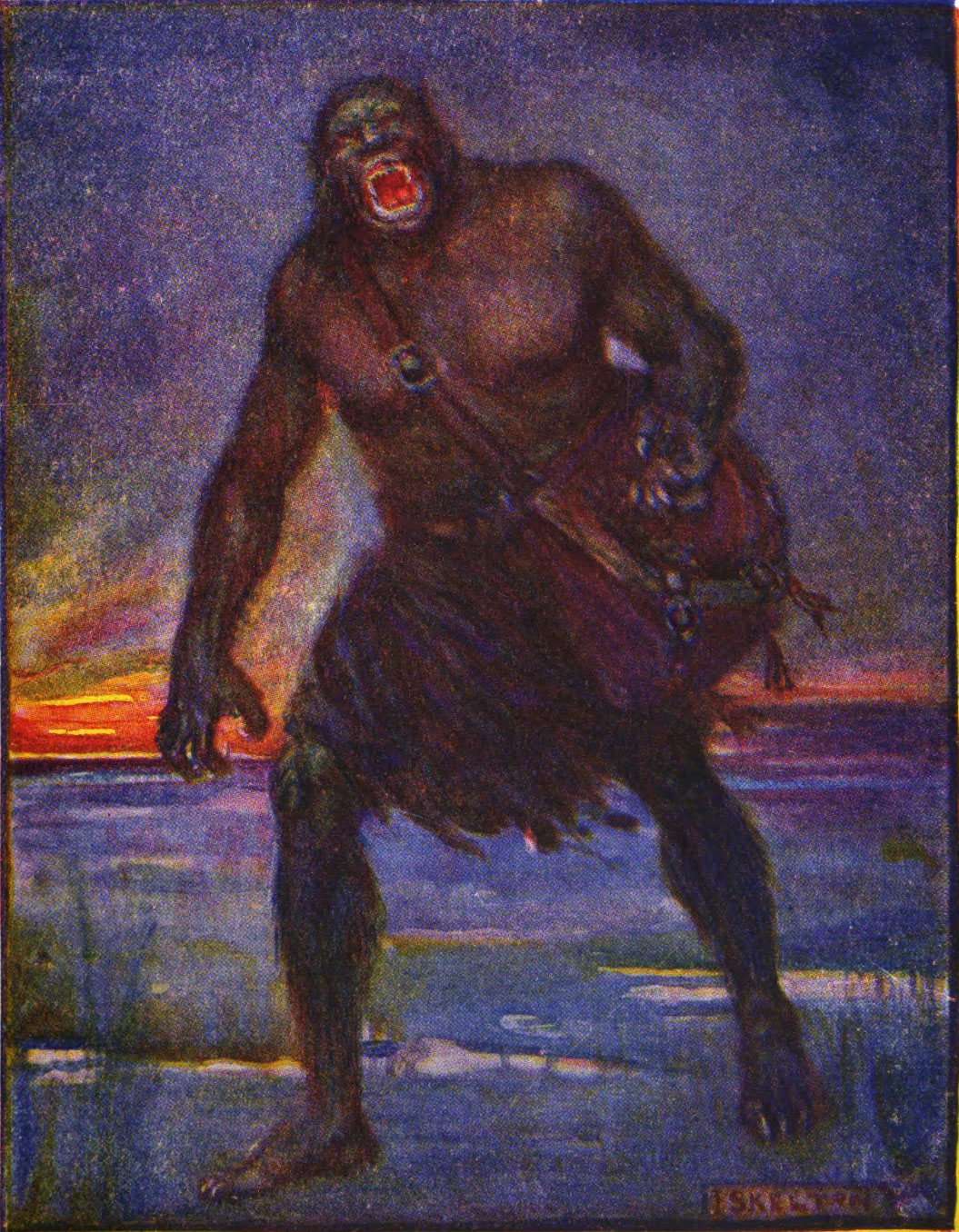
Joseph Ratcliffe Skelton, Public domain, via Wikimedia Commons
Grendel by Joseph Ratcliffe Skelton, Public domain, via Wikimedia Commons

When people want to believe something, having a prominent person say it’s true gives them permission to believe it. It’s all the better when there are media outlets dedicated to backing him up. That’s profitable for them because they too are selling permission, not persuasion.

This holds even for the most hateful lies that Trump tells, such as his awful justifications for separating children from their immigrant parents. In fact, lies as dark as those can be even more attractive.

Freud identified the urge behind this attraction in his “Civilization and Its Discontents.” As he wrote, we are all born with the desire to love, but also to hate; to create, but also to destroy.

Civilization requires that we control our hateful, destructive impulses. But it takes work: work that can cause fatigue, frustration, and sometimes fury—as we see frequently in infants, and, more or less often, in adults too.

Trump, like hatred-driven demagogues before him, offers a release from civilization. There is a form of exultation in just letting go and surrendering to anger, aggression, or even sheer cruelty.

The more frustration, resentment, pain, or shame people have in their lives, the more the promise of such release can feel irresistible. We’re all susceptible to it to some degree, even if we only go so far as to indulge in a Twitter war.

Many of Trump’s supporters claim they stick with him in spite of his darkness. They say it’s because of some overriding policy goal. Many are fooling themselves.

Often, the policy claim fails to survive even cursory scrutiny. It’s clear that Trump has failed to deliver on the goal or is actually working against it.

But scrutiny is beside the point, as will be found by anyone offering contrary evidence. The point is not to find truth but to obscure it—even from oneself. What’s needed is not evidence, but an excuse.

It’s all too common: moralistic reasons have been used to justify history’s worst atrocities.

Few Trump supporters would be able to admit it—although the admission would be more a recognition of human nature than of any special evil in themselves—but they may be drawn to him not in spite of, but because of his darkness.

Persuasion? That’s to be avoided. The real goal is permission.

Filed Under: Communication, Politics & Society, Uncategorized Tagged With: election2020, trump

Unarmed on the Battlefield of Democracy

June 24, 2020 by Spencer Critchley

One reason we have Trump is that we toss citizens onto the battlefield of democracy without giving them the weapons they need to defend themselves. We call it freedom, but it’s the freedom to choose among different ways of losing.

Isaac Cruikshank, Debating Society (Substitute for Hair Powder). London: Published by Laurie & Whittle, May 5, 1795. Etching and engraving via Wikimedia Commons.
Isaac Cruikshank, Debating Society (Substitute for Hair Powder), 1795. Public domain via Wikimedia Commons.

For example, a citizen should know how to have a useful debate. But few people ever learn the basic skills — as we see endlessly demonstrated on social media.

A useful debate is a joint attempt to prove or disprove a statement based on valid evidence and logic. It’s impossible to lose a useful debate. If I have to yield to the other person’s point, it means I’ve learned something. That’s a win. Losing is stubbornly sticking with being wrong.

But we seldom have useful debates. What we get instead is a series of infinitely branching assertions or insults, leading nowhere except to exhaustion and settled entrenchment in existing opinions. Neither side seems to realize they’re just doing it wrong.

And both sides lose.

There are winners, though: unscrupulous leaders who profit when citizens lose track of the thread. Nothing better for a demagogue than to distract and divide the citizenry with squabbling over anything and everything except what actually matters.

See my guide to the Hallmarks of a Bad Argument.

Filed Under: Communication, Politics & Society

  • « Go to Previous Page
  • Page 1
  • Page 2
  • Page 3
  • Page 4
  • Interim pages omitted …
  • Page 11
  • Go to Next Page »

Primary Sidebar

Search This Site

Broadcast Appearances

Spencer Critchley on Spectrum News 1 LA

Book

Patriots of Two Nations by Spencer Critchley
Kindle & paperback at Amazon. Audio book at Audible. EPUB format here.

New Music: Jailbreak

Cover image for the song "Jailbreak:" a ruined motel by the side of a lonely desert road.

Podcast

Dastardly Cleverness in the Service of Good

Social Media

Substack

YouTube

Music: The Critchleys

The Critchleys: Owen and Spencer Critchley

About Me

Spencer Critchley

Jump to Recent Posts

New Music: The Desert Mothers

The True Crisis

Outside in the Rain

The Liberal Backbone

Slowly and then all at once

On the Podcast: A Letter to a Friend Voting for Trump

“The War of the Worldviews” at TedX Pugwash

Recent Comments

  • terry rankin on “The War of the Worldviews” at TedX Pugwash
  • Spencer Critchley on Why Biden was right to link MAGA, the Confederacy & the Axis in his SOTU address
  • Spencer Critchley on Why Biden was right to link MAGA, the Confederacy & the Axis in his SOTU address
  • Scott Sexton on Why Biden was right to link MAGA, the Confederacy & the Axis in his SOTU address
  • Anonymous on Why Biden was right to link MAGA, the Confederacy & the Axis in his SOTU address

Photos

Spencer Critchley on Fox News' Cavuto
Barack Obama photo by Spencer Critchley
Bruce Springsteen photo by Spencer Critchley
Jay-Z photo by Spencer Critchley
Tiny American flag in crowd at political rally
Director Elizabeth Thompson & Composer/Audio Producer Spencer Critchley with the Emmy for the PBS documentary "Blink."

Find more photos here.

Privacy Policy

Learn how this site collects information and how you can control that.

© 2005–2026 Spencer Critchley