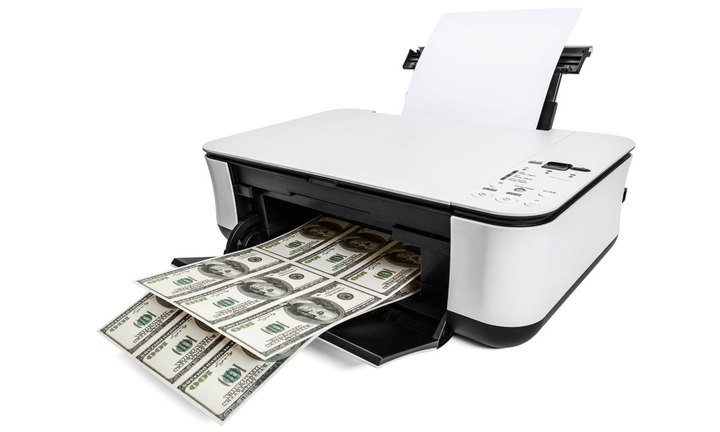
[Also published at Huffington Post.] Imagine if counterfeiting suddenly became legal. Say we asked people not to do it — but there would be no penalty if they did.
What would happen?
Simple: There would be an explosion of fake money. If people could buy things with currency worth nothing more than paper and some ink, many would, of course, do just that. Crooks would print up more and more counterfeit bills, which would start to take over from real money.
A venerable principle of economics explains why this happens. It’s named Gresham’s Law, after 16th century financier Sir Thomas Gresham.
The short version: Since sound money is expensive, and bad money is cheap, bad money proliferates and takes over the economy.
More recently, Gresham’s Law has been extended to information: Bad information drives out good, and for similar reasons.
In America in recent decades, an industry of information counterfeiters has sprung up, and it’s making a few, unprincipled people very rich, at the expense of everyone else.
And at the expense of democracy.
Bad money threatens the free market. But bad information threatens freedom itself. That’s because a vote is only as good as the information it’s based on. If your choices are based on illusions, what are they really worth?
Much of our population now votes, and makes other crucial decisions, based on bad information. Much of what they think they know about the world is untrue.
In effect, they live in a prison of lies, one whose walls they can’t even see.
When Everything You Know Is Wrong
- Our military is weak.
- Unemployment is rising.
- The stock market is falling.
- The deficit is exploding.
- Voter fraud is rampant.
- Crime is out of control.
- Many of the criminals are immigrants, flooding through our porous borders to rape and murder innocent Americans.
- Terrorists are coming the same way.
Given these terrifying facts, is it any wonder that Americans voted in 2016 for a candidate who promised to save us?
How could it have gone any other way? Hillary Clinton pledged to continue and build on the legacy of Barack Obama. How could any sensible person — any patriot — vote for that?
Except none of those “facts” was true. The voters who believed them were voting for and against illusions.
Think about what that means: the effect was the same as falsifying ballots. It’s just that the falsification happened before the vote instead of after.
Put another way, it’s like voters had a choice between door number 1 and door number 2, but for many of them, the numbers had been switched: door 1 was actually door 2, and vice versa.
Certainly there were people who voted for Donald Trump based on a more or less accurate picture of reality. But huge numbers — far more than were needed to swing the election — were just plain wrong about the issues on which they based their votes.
Let’s take another look at the “facts” these voters believed in.
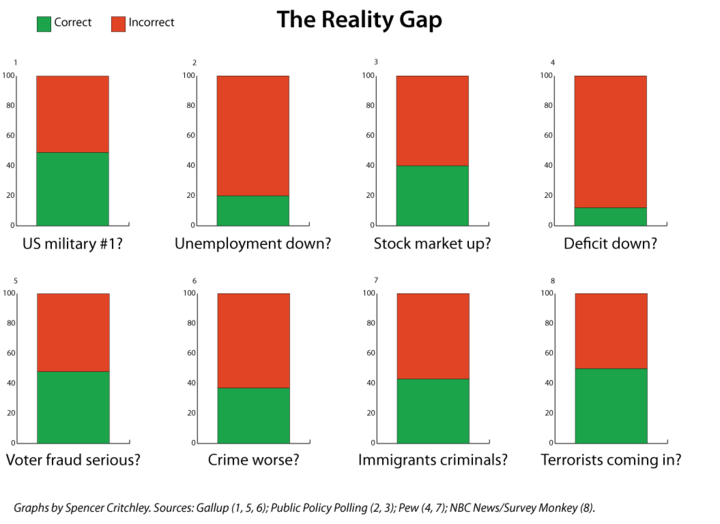
- According to a February, 2016 Gallup poll, only 49 percent of Americans thought the United States was the world’s top military power. In fact, as of 2016, the military budget of the United States was almost as high as those of the next 14 highest-spending countries — added together. The U.S. accounted for one-third of all the military spending in the world.
- According to a December, 2016 Public Policy Polling survey, 67% of Trump voters believed unemployment had increased during the Obama administration, and only 20 percent thought it had decreased. In fact, it had been cut in half, falling from more than 10 percent to below five percent. Some would argue that unemployment was actually worse than it looked, because the standard unemployment measure, known as U-3, doesn’t take into account people who have given up looking for work or who are marginally employed, such as those who have been forced to take part-time jobs. But the measure that does take them into account, U-6, had also fallen dramatically, from just over 17 percent to just over nine percent.
- The same PPP poll found that 60 percent of Trump voters thought the stock market had gone down under Obama. In fact, the Dow Jones Industrial Average was almost two and a half times higher at the end of Obama’s two terms than it was at the beginning. From the end of the Bush era slide, on March 6, 2009, the Dow more than tripled.
- Although the deficit had already been cut nearly in half by 2013, only 29 percent of Americans believed it was going down, and only 12 percent of Republicans did, according to a Pew poll at the end of that year.
- As of August, 2016, 52 percent of Republicans believed voter fraud was a serious problem, according to a Gallup poll. In fact, no credible study has ever found anything but minuscule levels of voter fraud.
Imagine if counterfeiting suddenly became legal. Say we asked people not to do it — but there would be no penalty if they did.
What would happen?
Simple: There would be an explosion of fake money. If people could buy things with currency worth nothing more than paper and some ink, many would, of course, do just that. Crooks would print up more and more counterfeit bills, which would start to take over from real money.
A venerable principle of economics explains why this happens. It’s named Gresham’s Law, after 16th century financier Sir Thomas Gresham.
The short version: Since sound money is expensive, and bad money is cheap, bad money proliferates and takes over the economy.
More recently, Gresham’s Law has been extended to information: Bad information drives out good, and for similar reasons.
In America in recent decades, an industry of information counterfeiters has sprung up, and it’s making a few, unprincipled people very rich, at the expense of everyone else.
And at the expense of democracy.
Bad money threatens the free market. But bad information threatens freedom itself. That’s because a vote is only as good as the information it’s based on. If your choices are based on illusions, what are they really worth?
Much of our population now votes, and makes other crucial decisions, based on bad information. Much of what they think they know about the world is untrue.
In effect, they live in a prison of lies, one whose walls they can’t even see.
When Everything You Know Is Wrong
- Our military is weak.
- Unemployment is rising.
- The stock market is falling.
- The deficit is exploding.
- Voter fraud is rampant.
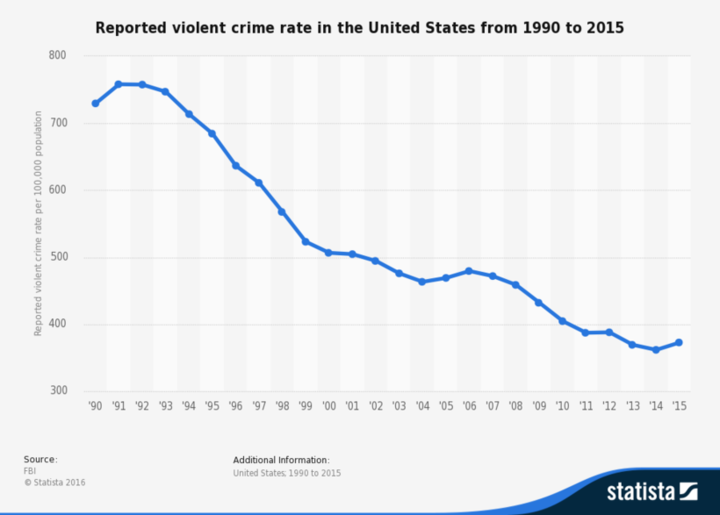
- Crime is out of control.
- Many of the criminals are immigrants, flooding through our porous borders to rape and murder innocent Americans.
- Terrorists are coming the same way.
Given these terrifying facts, is it any wonder that Americans voted in 2016 for a candidate who promised to save us?
How could it have gone any other way? Hillary Clinton pledged to continue and build on the legacy of Barack Obama. How could any sensible person — any patriot — vote for that?
Except none of those “facts” was true. The voters who believed them were voting for and against illusions.
Think about what that means: the effect was the same as falsifying ballots. It’s just that the falsification happened before the vote instead of after.
Put another way, it’s like voters had a choice between door number 1 and door number 2, but for many of them, the numbers had been switched: door 1 was actually door 2, and vice versa.
Certainly there were people who voted for Donald Trump based on a more or less accurate picture of reality. But huge numbers — far more than were needed to swing the election — were just plain wrong about the issues on which they based their votes.
Let’s take another look at the “facts” these voters believed in.
- According to a February, 2016 Gallup poll, only 49 percent of Americans thought the United States was the world’s top military power. In fact, as of 2016, the military budget of the United States was almost as high as those of the next 14 highest-spending countries — added together. The U.S. accounted for one-third of all the military spending in the world.
- According to a December, 2016 Public Policy Polling survey, 67% of Trump voters believed unemployment had increased during the Obama administration, and only 20 percent thought it had decreased. In fact, it had been cut in half, falling from more than 10 percent to below five percent. Some would argue that unemployment was actually worse than it looked, because the standard unemployment measure, known as U-3, doesn’t take into account people who have given up looking for work or who are marginally employed, such as those who have been forced to take part-time jobs. But the measure that does take them into account, U-6, had also fallen dramatically, from just over 17 percent to just over nine percent.
- The same PPP poll found that 60 percent of Trump voters thought the stock market had gone down under Obama. In fact, the Dow Jones Industrial Average was almost two and a half times higher at the end of Obama’s two terms than it was at the beginning. From the end of the Bush era slide, on March 6, 2009, the Dow more than tripled.
- Although the deficit had already been cut nearly in half by 2013, only 29 percent of Americans believed it was going down, and only 12 percent of Republicans did, according to a Pew poll at the end of that year.
- As of August, 2016, 52 percent of Republicans believed voter fraud was a serious problem, according to a Gallup poll. In fact, no credible study has ever found anything but minuscule levels of voter fraud.
These are just some examples from the alt reality many Americans now inhabit. Among other false but popular beliefs that influenced voters in the 2016 election: Obama was a Kenyan born Muslim who was going to take away all our guns, FEMA planned concentration camps for conservatives, the U.S. military was going to invade Texas, and Hillary was the leader of a sex slavery ring run out of a Washington, D.C. pizza restaurant.
Since the election, most explanations of how Trump won it have focused on factors that might have accounted for, at most, a few percentage points each in state-by-state vote totals: interference by Russia and Wikileaks, Hillary’s emails and/or the media’s obsession with them, mistakes by Hillary’s campaign, disruptive comments by FBI Director James Comey, or the Democratic Party being too far right, too far left, or too disconnected from the white working class.
Some or all of these likely had an influence. But remember, Hillary lost by less than 78,000 votes [update: this replaces the earlier estimate of several hundred thousand votes with the final result] in three battleground states, while winning the popular vote overall.
Whatever the causes, her defeat was razor thin.
Now look again at the percentages in my eight examples: all the margins are in the tens of percentage points, and many represent strong majorities of the relevant voters.
That means that any of the most popular explanations for the election result shrinks to insignificance when compared with this one:
The misinformation industry threw our election.
How Lying Became a Multi-Billion Dollar Business
Believe it or not, there was a time when self-described journalists wouldn’t have been allowed to just make stuff up all day long without presenting opposing viewpoints. That time was before 1987, when the federal Fairness Doctrine was eliminated.
The Fairness Doctrine was a policy of the Federal Communications Commission (FCC) adopted in 1949. It required broadcasters both to present important and controversial topics, and provide time for opposing viewpoints.
It was based on the idea that the public owned the airwaves. Broadcasters had licenses to use this public property, but not to abuse its owners by misleading them.
But that rule went away in 1987, as part of deregulation under the Reagan administration. Conservatives thought the Fairness Doctrine impinged on free speech, and that free market competition would take care of fairness.
Unfortunately, the effect was like removing all guarantees behind a currency.
Peddlers of information were now free to sell fiction as fact, like counterfeiters printing their own money. And just like counterfeit money, misinformation is really cheap to produce, and has a huge market.
Emotion sells. If you’re not required to tell the truth, you can just make up addictively provocative stuff, all day long. And since you don’t need to put any time or money into actual reporting or fact-checking, it costs you next to nothing to churn it out and rack up the revenues.
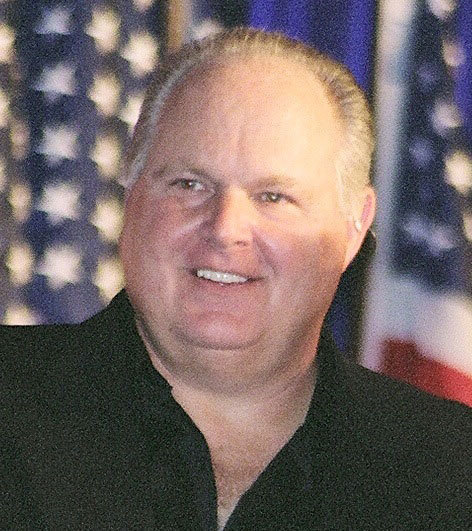
And what do you know, after 1987 right wing talk became the top commercial talk radio format in the U.S. Further deregulation made the format particularly lucrative, by allowing the formation of conglomerates like Clear Channel. They could afford to pay big syndication fees to the most popular hosts, led for many years by Rush Limbaugh, who got very rich by making his listeners very angry. Not surprisingly, Rush inspired imitators: Glenn Beck, Sean Hannity, Alex Jones, Michael Savage, Mark Levin, and many more.
TV’s turn had to wait for the arrival of digital cable and satellite technologies, which brought a proliferation of channels, along with the need to fill them with content. That enabled Rupert Murdoch’s 1996 creation of Fox News, which quickly began its rise to number one among basic cable channels.
As with right wing talk radio, Fox isn’t really in the news business, but a news-like form of the entertainment business. Despite its (possibly deliberately) ironic slogan of “Fair and Balanced,” what Fox sells is sensation, with objective information playing a distinctly secondary role.
There are legitimate reporters at Fox. But the network’s cash cows are the heavily biased, highly provocative opinion shows, like Fox and Friends, Hannity, and the industry-leading O’Reilly Factor.
New technologies also enabled the right-wing web. The introduction of the graphical Mosaic browser in 1993, followed by easy site-building tools and the rise of cheap bandwidth, meant almost anyone could be a publisher. Soon enough, that came to include hot button-pushing “news” sites, from the Drudge Report, to InfoWars, to WorldNet Daily, to Breitbart, to who knows how many more.
There was money in all of it — a lot of money.
In 2016, Forbes magazine ranked Rush Limbaugh the world’s 10th highest-paid celebrity, with an estimated income of $79 million. His net worth is variously estimated at between $350 million and $500 million.
Fox News’ 2015 revenue was projected at $2.3 billion, and the 2016 number will no doubt turn out to have been even higher, given that Fox broke ratings records on the back of the most attention-grabbing election campaign ever. Forbes estimates the net worth of Rupert Murdoch, who also owns other major media properties, at $13 billion.
In 2012, Business Insider’s Henry Blodget estimated that the Drudge Report was earning $50,000 a day, and that founder Matt Drudge must be worth hundreds of millions of dollars. Blodget made this startling comparison:
In short, the Drudge Report is almost as big a digital media property as The New York Times.
That’s absolutely staggering.
Why?
Because The New York Times is produced by ~1,200 journalists. The Drudge Report is produced by one.
Blodget is exaggerating a bit here: earlier in his article he estimates the total Drudge staff at “maybe three.”
