• Skip to primary navigation
  • Skip to main content
  • Skip to primary sidebar

Spencer Critchley

  • Home
  • About
  • Media Appearances
    • Broadcast Appearances
    • Print & Web Coverage
    • My Reporting & Commentary
    • Podcast
    • “Saving Democracy” Events
    • News: Real or Fake?
    • Hallmarks of a #BadArgument
  • Music
  • Photos
  • Subscribe
  • Contact

Leadership & Management

Running From the Polls, Democrats Stumble Into Leading on Impeachment

September 29, 2019 by Spencer Critchley

As I’m not the first to point out, when Democrats see bad polls, they run from them. When Republicans see bad polls, they change them, through persuasion.* With polls showing a dramatic swing in favor of impeaching President Trump, Congressional Democrats have stumbled into leading on the issue, now that leading and fleeing point in the same direction.

On Friday’s “Morning Joe” (Sept 27, 2019), House Speaker Nancy Pelosi explained her new support for impeachment: her position hasn’t changed, the situation has changed, because the glaring clarity of Trump’s abuse of power in the Ukraine scandal has made the case for impeachment so easy for the public to see and understand. She quoted Abraham Lincoln’s famous assertion (from his first debate with Stephen Douglas):

With public sentiment, nothing can fail; without it nothing can succeed.

I respect Pelosi, and I often agree with her choices of pragmatism over purity. But here’s what’s missing from her precis of politics: the rest of what Lincoln said.

…Consequently he who moulds public sentiment, goes deeper than he who enacts statutes or pronounces decisions. He makes statutes and decisions possible or impossible to be executed. [Emphasis added.]

The case for Trump’s impeachment was made a long time ago, certainly by the time Robert Mueller released his report and came as close as he could to calling for it in the face of the Office of Legal Counsel’s directive against indicting a sitting president. But Congressional Democrats couldn’t rise to the challenge of making the case to the public.

They had to wait for Trump to do that for them.

All smart politicians check polls, often daily. But there’s a difference between checking polls and being led by them. Leadership means standing in front of the crowd, not behind.

Democrats in Congress now find themselves in front of a crowd, one that’s growing. All they need to do is to keep moving forward. Hopefully they’ll get used to the feeling.

*I think I first heard Bill Maher say this, but I’m not sure if he originated it.
Filed Under: Communication, Leadership & Management Tagged With: Democratic Party, impeachment, Nancy Pelosi

Smacked Around by the Schoolyard Bully, Congressional Democrats Threaten to Maybe Someday Do Something

September 21, 2019 by Spencer Critchley

I often call out Republicans in Congress for their cowardice and complicity in the face of Trump’s assault on our democracy. But many Congressional Democrats are making it hard to see how they’re any better.

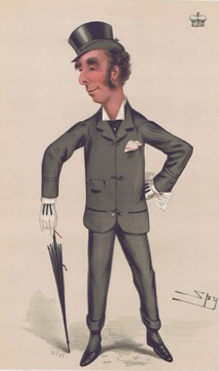
Caricature of the Marquess of Queensberry, namesake of the boxing rules, from Vanity Fair, Nov. 10, 1877 via Wikimedia Commons

If these Democrats continue to say that Trump is guilty of impeachable offenses, as he so obviously is, but then shy away from impeaching him, their overriding message, no matter what explanation they offer, is that they’re too weak and fearful to follow words with actions.

It would be better just to stay quiet.

Like it would be better not to invite people like Corey Lewandowski to show utter contempt for Congress, and just sit there and take it. They only play the helpless victims of the schoolyard bully:

SMACK — “Hey! That’s not right!”
 SMACK — “You’re breaking the rules!
 SMACK — “If you do that again, I’ll tell!”
 SMACK.

Given the choice between the bully and the bully’s victims, many voters will choose the bully.

They may feel sorry for the victims. But they sure won’t follow them.

That’s because above all, leadership requires strength, or at least the appearance of it. If you can’t stand up for us, why would we stand behind you?

And you can’t convince people you’re strong by talking about it. You have to show it.

It means you may have to get in an actual fight, which means getting hit, and hitting back. Not scheduling a meeting to consider hitting back at some point in the future.

Most importantly, getting in an actual fight means taking the risk that you’ll lose.

That’s scary — but that’s all it is. Leaders know that losing is not the worst outcome.

If you do lose, you still will have shown the character and courage of a leader, one who can lead again in the next battle, or inspire others to.

But if you won’t even fight, you’ve lost already.

And you should face, at least, this: You’re not a leader.

Filed Under: Leadership & Management, Politics & Society Tagged With: Democratic Party, leadership

Beto: Wrong on Guns, Right on Guts

September 15, 2019 by Spencer Critchley

Beto O'Rourke
Beto O’Rourke photo by Gage Skidmore
via Wikimedia Commons

Are Democrats impeaching the president?

Yes. No. Maybe.

You see, it could be the right thing to do, but it’s also the risky thing to do. So they kind of are and kind of aren’t.

God forbid they just choose one and fight for it.

It’s a perfect Democratic stance, meaning not a stance at all. More of a straddle. Balanced, but wobbly.

And it sends the one big meta-message that so often drowns out everything else Democrats say: “Looking for leadership? Please, look somewhere else — anywhere else.” So, many voters do.

At the most recent Democratic debate, Beto O’Rourke came out and said what many gun owners believe all Democrats would say if they had the guts: “I’m coming for your guns.” (Assault rifles, in this case.)

Now in fact, I’m one of many Democrats who think Beto’s position here is a mistake. I agree with him that the average person shouldn’t own an assault rifle — but millions do. And I believe that in a democracy it’s both better and more sustainable to build support for a dramatic change like this instead of using the power of the government to force it.

I also think that Beto has created a political problem for all the Democratic candidates. Chris Coons is right when he says Beto’s statement will be repeated over and over in the other side’s attack ads and fundraising appeals.

But I think Beto’s boldness is exactly right. And it’s exactly what more Democrats need to find within themselves.

Instead, too many Democrats seem to think they can find a way to appear bold without taking a risk. In so doing, they come across as fearful and untrustworthy.

There’s because here’s no way around it: leadership requires — is — the taking of risks. If a leader can’t take a risk, they’re not a leader, they’re a follower, and what do we need them for? Followers are not in short supply.

Democrats have a natural electoral advantage that should mean we almost never lose: there are far more of the non-rich people we care most about than the rich people the Republicans care most about.

And yet, way too often, we do lose — including, in 2016, to the worst presidential candidate in history. It’s easy to blame Republicans for this by pointing to malfeasance like their race-baiting, gerrymandering, and institutionalized lying.

But Democrats also need to look in the mirror and ask themselves this question: Why are there millions of natural Democratic voters who can’t bring themselves to choose our candidates?

We need to remember that ultimately that choice is not based on policies, but the person. It’s the same as it has been since we were hunter-gatherers. We’re looking for the biggest, strongest, and bravest among us, and we identify them based on actions and nonverbal cues like posture, eye contact and tone of voice.

And yet so many Democratic candidates will happily disappear down policy rabbit holes, as they did again at the most recent debate, as if they think a presidential campaign is just a long seminar, instead of a crucible of character.

By taking a stand, even if a mistaken one, Beto showed voters what they want more than any particular policy, a strong leader. In doing that, I suspect he may even win over some hard core gun rights backers who’ll respect his gumption more than they hate his position.

Note that Donald Trump, who in reality is weak and incompetent, only proves my point: he fooled people into thinking he was a strong leader by showing them who he really was. By blurting out everything that popped into his head during the 2016 campaign, he came across as authentic. The far more qualified Hillary Clinton, meanwhile, came across as someone who had poll-tested whether to say “hi” or “hello.”

Imagine the power of marrying authenticity with actual character and ability.
Luckily, imagining that is not too hard. Barack Obama gave us a great example.

And happily, Beto’s risky statement on guns wasn’t the only bright spot at the debate. Pete Buttigieg nailed what matters most in one powerful sentence:

“Part of how you can win is to know what’s worth more to you than winning.”

Filed Under: Communication, Leadership & Management, Politics & Society

What Makes a Life-Changing Teacher

March 24, 2019 by Spencer Critchley

Kamala Harris is doing a nice thing on Twitter, asking people to share stories of teachers who changed their lives. Here’s one of several I can think of right away: Kenneth Clegg, the chemistry teacher at Warwick Academy in Bermuda. He made us all love to be in his class because he so clearly loved all of us.

My dad, David Critchley, who knew what he was talking about, would have said Mr. Clegg was an example of what really matters in good teachers — more even than how well they know their subject (although Mr. Clegg knew his very, very well). Quoting Charles Truax, Dad said three simple things make the difference: empathy, warmth, and genuineness.

The trouble is, those are hard to turn into checklist items in a teacher training curriculum. You don’t so much learn them as you’re given them, usually in childhood, by your parents or other mentors — or, if you’re not so lucky, through the hard work of clearing away all the junk that gets built up in their place.

Filed Under: Leadership & Management, Teaching & Learning

Trump Isn’t Getting Better, America Is Getting Worse

October 28, 2018 by Spencer Critchley

[Also published at Medium.] After the shock of Donald Trump winning the presidency, the hope many of us clung to was that he would grow in office.

Instead, America has shrunk.

There was some reassurance at the beginning, as his poll numbers fell — especially once they reached the low 30s, because 30 percent might as well be zero. As pollsters will tell you, it’s the noise floor of politics: there are always about that many voters who are uninformed, careless, or crazy.

But lately, support for Trump has been rising, at times approaching 50 percent.

This after the Muslim ban, Charlottesville, the attacks on our institutions, the attacks on our allies, the children in cages, the thousands of lies, and on, and on, and on.

Nearly half the country is OK with all that. And a small but growing number of violent extremists are emboldened by it.

We shouldn’t be surprised that Trump isn’t getting better. He really doesn’t seem able to.

But neither should we be surprised that instead, America is getting worse.

We like to say “This is not who we are,” and “We’re better than this.” Normally, those assertions are true.

And yet with the wrong leadership, it is who we are. Yes, America is exceptional. It’s the first country to be founded not on an ethnicity but on an idea, and that idea, freedom and equality for all, is a glorious one.

But Americans are human beings, and human beings are creatures of light and dark, of hope and fear. If a leader constantly summons the worst in us, it will come forth.

History has shown, over and over and around the world, what can happen. Still, we think it couldn’t happen here. Instead we ask, “What was wrong with those people?”

The answer is, they were people. There was nothing wrong with them that isn’t also wrong with us — as a nation of immigrants, we literally are them.

Leadership matters.

But in a democracy, so does citizenship.

We have chosen a terrible leader.

If we want better, we must be better.

Vote.

Filed Under: Leadership & Management, Politics & Society

  • « Go to Previous Page
  • Page 1
  • Page 2
  • Page 3
  • Page 4
  • Go to Next Page »

Primary Sidebar

Search This Site

Broadcast Appearances

Spencer Critchley on Spectrum News 1 LA

Book

Patriots of Two Nations by Spencer Critchley
Kindle & paperback at Amazon. Audio book at Audible. EPUB format here.

New Music: Jailbreak

Cover image for the song "Jailbreak:" a ruined motel by the side of a lonely desert road.

Podcast

Dastardly Cleverness in the Service of Good

Social Media

Substack

YouTube

Music: The Critchleys

The Critchleys: Owen and Spencer Critchley

About Me

Spencer Critchley

Jump to Recent Posts

New Music: The Desert Mothers

The True Crisis

Outside in the Rain

The Liberal Backbone

Slowly and then all at once

On the Podcast: A Letter to a Friend Voting for Trump

“The War of the Worldviews” at TedX Pugwash

Recent Comments

  • terry rankin on “The War of the Worldviews” at TedX Pugwash
  • Spencer Critchley on Why Biden was right to link MAGA, the Confederacy & the Axis in his SOTU address
  • Spencer Critchley on Why Biden was right to link MAGA, the Confederacy & the Axis in his SOTU address
  • Scott Sexton on Why Biden was right to link MAGA, the Confederacy & the Axis in his SOTU address
  • Anonymous on Why Biden was right to link MAGA, the Confederacy & the Axis in his SOTU address

Photos

Spencer Critchley on Fox News' Cavuto
Barack Obama photo by Spencer Critchley
Bruce Springsteen photo by Spencer Critchley
Jay-Z photo by Spencer Critchley
Tiny American flag in crowd at political rally
Director Elizabeth Thompson & Composer/Audio Producer Spencer Critchley with the Emmy for the PBS documentary "Blink."

Find more photos here.

Privacy Policy

Learn how this site collects information and how you can control that.

© 2005–2026 Spencer Critchley