• Skip to primary navigation
  • Skip to main content
  • Skip to primary sidebar

Spencer Critchley

  • Home
  • About
  • Media Appearances
    • Broadcast Appearances
    • Print & Web Coverage
    • My Reporting & Commentary
    • Podcast
    • “Saving Democracy” Events
    • News: Real or Fake?
    • Hallmarks of a #BadArgument
  • Music
  • Photos
  • Subscribe
  • Contact

democracy

America Is A Creed, Not a Tribe — And Too Few Americans Know Why That Matters

July 10, 2017 by Spencer Critchley

Statue of Liberty at night
0X010C via Wikimedia Commons

[Also published at Huffington Post.] Donald Trump’s recent speech in Poland sent chills down the spines of people around the world who believe in small l, small d liberal democracy. Notably this part:

We must work together to confront forces, whether they come from inside or out, from the South or the East, that threaten over time to undermine these values and to erase the bonds of culture, faith and tradition that make us who we are. If left unchecked, these forces will undermine our courage, sap our spirit, and weaken our will to defend ourselves and our societies.

What’s so disturbing? Many Trump supporters honestly see no problem — why shouldn’t we defend America, in partnership with our allies?

Because what Trump is describing here isn’t America. And sadly, many Americans failed to notice.

America, as patriots (including me) like to point out, is exceptional. But if some of those patriots don’t see the problem in what Trump said in Poland — and has said in other, starker, ways — then I submit they don’t understand why America is exceptional.

Because it isn’t bonds of culture, faith, and tradition that “make us who we are” — and it certainly isn’t xenophobic opposition to the South or the East, in defense of an ethnocentric West. Culture, faith, and tradition are important in all countries. But in America, they’re not essential. Those things are essential only to the nations of the past: nations that were formed from tribes.

What’s exceptional about America is that it isn’t a tribe. It’s a creed.

You’re not an American because of your blood, or the soil on which you were born, or the religion you practice. You’re an American because you believe in the American creed. That’s the essential miracle of this country.

The creed was defined in the Preamble to the Declaration of Independence, which its author Thomas Jefferson intended as “an expression of the American mind,” and which, as I hope we all still remember, begins with these words:

We hold these truths to be self-evident, that all men are created equal, that they are endowed by their Creator with certain unalienable Rights, that among these are Life, Liberty and the pursuit of Happiness.

It’s why Jefferson built his first Inaugural Address to lead to this climax:

These principles [freedom of religion; freedom of the press; and freedom of person, and others] form the bright constellation, which has gone before us and guided our steps through an age of revolution and reformation. The wisdom of our sages, and blood of our heroes have been devoted to their attainment: they should be the creed of our political faith; the text of civic instruction… (Emphasis added.)

It’s why Abraham Lincoln summoned that creed anew to mark the end of the Civil War:

Four score and seven years ago our fathers brought forth on this continent, a new nation, conceived in Liberty, and dedicated to the proposition that all men are created equal.

It’s why Emma Lazarus wrote her sonnet for the Statue of Liberty, depicting it as a “New Colossus”: a symbol not of nationalistic conquest, like the ancient Colossus of Rhodes, but of the far greater power of democratic values:

Not like the brazen giant of Greek fame, With conquering limbs astride from land to land; Here at our sea-washed, sunset gates shall stand A mighty woman with a torch, whose flame Is the imprisoned lightning, and her name MOTHER OF EXILES. From her beacon-hand Glows world-wide welcome; her mild eyes command The air-bridged harbor that twin cities frame.

“Keep, ancient lands, your storied pomp!” cries she With silent lips. “Give me your tired, your poor, Your huddled masses yearning to breathe free, The wretched refuse of your teeming shore. Send these, the homeless, tempest-tost to me, I lift my lamp beside the golden door!”

It’s why in 1918 William Tyler Page and the U.S. Congress sought to inspire American soldiers with “The American Creed”:

I believe in the United States of America as a government of the people, by the people, for the people; whose just powers are derived from the consent of the governed; a democracy in a republic; a sovereign Nation of many sovereign States; a perfect union, one and inseparable; established upon those principles of freedom, equality, justice, and humanity for which American patriots sacrificed their lives and fortunes…

And it’s why the British poet G.K. Chesterton described America as “the only nation in the world that is founded on a creed.”

In a land where religion and the state are carefully separated — for the protection of both — the creed is the basis of what has been called our civil religion.

In Poland, Trump was speaking words of ethnic nationalism. They are words that could describe many countries.

But not America.

They are the words of someone who doesn’t know what America is.
Filed Under: Politics & Society Tagged With: democracy, Donald Trump

It Isn’t Just Trump: The Roots Of Democracy’s Crisis Are Many and Deep

May 10, 2017 by Spencer Critchley

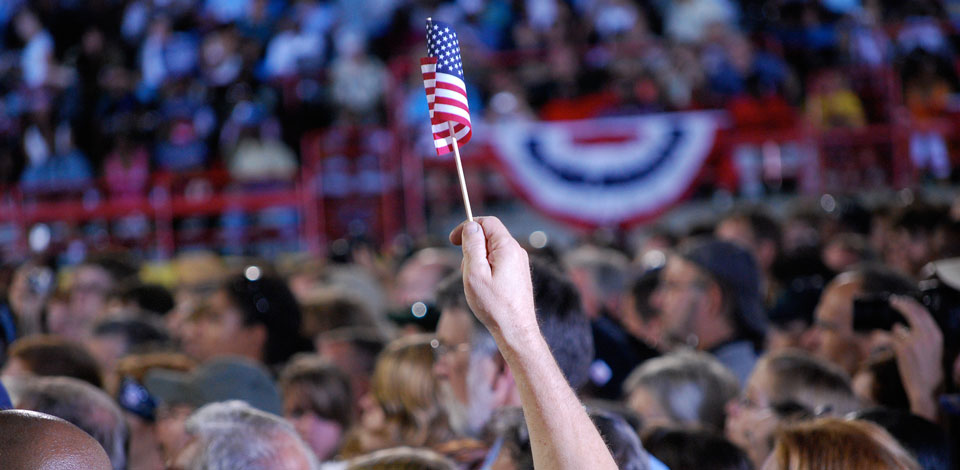
Tiny American flag in crowd at political rally

[Also published at Huffington Post.] I’ll soon be taking part in a panel discussion on the crisis of democracy.

In preparation, I started a list of answers to the question, “How did we get here?”

I was amazed at how fast that list grew.

Many see Donald Trump as an expression of that crisis — though some look at him and see the problem and others, the solution. But, as my list showed me so clearly, Trump doesn’t come close to being the explanation. And we need one — or more likely, many — as we try to figure out not just how we got here, but where we’re going.

So I’d like to share my list — no doubt still incomplete — and invite your thoughts. Here are some of the reasons I think democracy is in crisis.

The fight, from the founding, over what democracy is. Should the federal government be strong, as Alexander Hamilton argued, or weak, as Thomas Jefferson did? Which is more important, the freedom of the group, or of the individual? How do we balance respecting the will of the people with protecting against demagoguery and mob rule?

… And over what America is. Is the essence of America its democratic creed — as Jefferson asserted — or is it an ethnic homeland, as Andrew Jackson saw it? Under the present administration, the issue is very much alive.

Slavery and its aftermath. Although the Civil War ended in 1865, America only started to become a full democracy a century later, when African-Americans were first able to exercise the franchise in full. To this day, we live with the lingering effects of racial injustice and its twins, shame, and denial. As one example among many…

Voter suppression, supposedly justified by insignificant levels of voter fraud.

The backlash to increasing social equality. Experiments show that people value relative social status more than money. Those close to the bottom are especially afraid of letting others climb past them — one explanation for why poor people sometimes vote against their own economic interest. Others are cultural anxiety — fear of losing one’s traditional culture, independent of active prejudice against others — and outright bigotry.

The backlash to economic inequality, as wealth gains have flowed to the top while wages for the middle while working classes have stagnated. Researchers disagree, though, about how much this drove the recent election results, as compared with ethnic and cultural tensions.

The culture war, especially since the 1960’s, over moral and religious values. Although the Constitution says there can’t be an official religion in the United States, there used to be one by default — church and state only really got separated recently. And for all that liberals saw the 60’s as a time of progress, especially with the advancement of women, minorities and gay people, conservatives saw the beginning of a national decline into chaos. That bolstered their support for law and order, and, potentially, more authoritarian leadership.

The hyper-politicization of the judiciary. FDR may have started it by trying to pack the Supreme Court, but it was 1973’s Roe vs. Wade decision that made politics a litmus test for every new justice thereafter. When one side sees abortion as a civil right and the other sees it as murder, democratic compromise is hard to achieve. So people turn to alternatives, like the courts.

Terrorism, which has scared many of us into compromising democratic values in favor of security.

The abandonment of the Enlightenment and its focus on reason: on the left as well as the right, we increasingly prefer emotion and intuition, whether because of religion, new age spirituality, the self-help industry, Hollywood, or other causes. A related phenomenon is The Death of Expertise as described by author Tom Nichols: on the right and the left, we find people who seem to believe all opinions are equally valid, no matter how ill-informed.

Religious extremism, by which some claim that God’s law should outweigh any that humans create — and that they know exactly how God would vote. It has a long history in the U.S., and grew stronger through the use of media, starting with radio pioneers like Father Coughlin and continuing on TV and the internet.

Illiberal liberalism. The right has its moral absolutists, but the left does, too. Let me be clear, I don’t think it’s “political correctness run amok” to object to hateful speech. But we’ve seen some cases of speakers being silenced simply because others strongly disagreed with them. There’s a reason the First Amendment comes first: to protect democracy, we have to tolerate a lot of disagreement before shutting people down.

The weakening of institutions, including education and journalism, the two pillars that make government by an informed citizenry viable, as our founders well knew.

Uninvolved citizens, with low interest in politics, and low propensity to vote, whether because of loss of faith in the process, or lack of civics education, or…

Entertainment and consumption as opiates of the masses. We seem to be Amusing Ourselves to Death, as author Neil Postman predicted: choosing to surrender our rights and duties as citizens in exchange for endless diversion.

Entertainment industry clichés about politics and government. In movies and TV shows, it’s all corruption, full of shadowy conspiracies, and only the heroic individual can beat it. People who have worked in public service know this is far from true, but many, many Americans are sure that it is.

Scientific marketing of candidates and causes, leading to ever more partisan and divisive campaigns, which are based on pushing psychological buttons instead of making coherent policy arguments. After the birth of modern propaganda in the 1920’s, this trend really got going in the 60’s with the Kennedy and Nixon campaigns, got a big boost from Karl Rove and his data-driven targeting, went hyperbolic in the 90’s with psychologist Frank Luntz’s toxic messaging strategy for Newt Gingrich and his Republican Revolution, and is now exploiting all the tools that marketing, psychology, and technology have to offer.

Negative branding of government as a political tactic, especially starting with Reagan’s message of “government is the problem, not the solution” message.

Pork barrel politics — as well as less pork barrel politics. Pork barrel spending by Congress causes people to lose faith in the system of checks and balances. But reducing pork, say by banning earmarks, may have the unanticipated side-effect of making Congressional deal-making harder, and recalcitrance easier, by reducing the leverage leaders have over rank and file members.

Gerrymandering, which reduces incentives for compromise.

The removal of restrictions on campaign finance, along with the growth of lobbying, and the new role of billionaires as power brokers to rival the parties. These are also destructive to voters’ faith in the system.

The end of the Fairness Doctrine, making it legal to present opinion and provocation as news, and thereby possible to make huge amounts of money — a segment of media and politics became a highly profitable outrage industry.

The rise of talk radio, digital cable TV, and the internet, leading to the fragmentation of world views, the growth of the outrage industry, and greater reach for extremists.

Urbanization, which has made the rural/urban divide, now much more extreme than it was at the founding — and it was very divisive then, as the hostility between Jefferson and Hamilton showed.

The Big Sort of Americans into like-minded communities, as described by author Bill Bishop, enabled by technologies like electricity, air conditioning, and highways.

Web and social media algorithms that exacerbate the Big Sort by showing people only content that they’re likely to agree with.

Anxiety over the increasing complexity of the world, giving rise to a longing for simple solutions, and making authoritarianism more attractive.

Fake news via scam websites, social media, and organized campaigns, enabled by the near-zero cost of producing and distributing counterfeit information, and the difficulty many of us have detecting it.

Postmodern philosophy going mainstream, migrating from the academic theory to playbook. We now see some political operatives explicitly arguing that reality is whatever we say it is.

What else?

This post was prepared in preparation for the panel discussion “Is There Hope for Democracy?” at the Irvine Auditorium in Monterey, California, on May 17, 2017.

Filed Under: Politics & Society Tagged With: democracy, Donald Trump, populism

Putin Wins Simply by Showing That a Clown Can Be Elected President of the United States

December 31, 2016 by Spencer Critchley

(Also published at Huffington Post.) Is our next president a Russian agent? Because of Donald Trump’s relentless shilling for Vladimir Putin, that once unthinkable question is being asked seriously by major news outlets.

To at least some degree, the answer, obviously, is yes. An agent is someone who acts on behalf of another, and wittingly or not, Trump does exactly that for Russia.

Photo of Donald Trump
Donald Trump, Aug. 19, 2015 (Wikimedia Commons)

But looked at from Putin’s point of view, it hardly matters what Trump might or might not be up to.

Because if Putin’s goal is to delegitimize American democracy, he’s already won.

How better to delegitimize democracy than by showing that an utter clown can be elected president of the United States?

Trump doesn’t have to do much more of anything for Putin in order to be counted as one of the most successful Russian agents ever.

All he has to do, starting January 20, is show up for work every day.


Filed Under: Politics & Society Tagged With: democracy, Donald Trump

The 2 Reasons This Is the 1 Time We Needed the Electoral College

December 31, 2016 by Spencer Critchley

(Also published at Huffington Post.) I could hardly have been more shocked and disappointed that Donald Trump won the election. But I strongly opposed the idea of the Electoral College overturning the results.

Certainly Trump seemed to fail the fundamental test defined by Electoral College inventor Alexander Hamilton: he was unqualified.

[The Electoral College process] affords a moral certainty,: that the office of President will never fall to the lot of any man who is not in an eminent degree endowed with the requisite qualifications. Talents for low intrigue, and the little arts of popularity, may alone suffice to elevate a man to the first honors in a single State; but it will require other talents, and a different kind of merit, to establish him in the esteem and confidence of the whole Union….” (Alexander Hamilton, Federalist Paper 68)

Almost sounds like Hamilton and Trump had already met.

But democracy means you have to live with other people’s opinions, and that would usually include their opinions of what “qualified” means.

But then came the deal breakers — and my support for the Hamilton Electors:

  1. Corruption.
  2. Foreign control.
Alexander Hamilton portrait by John Trumbull, 1806 (Public domain via Wikimedia Commons)


Here’s what else Hamilton warned about:

Nothing was more to be desired than that every practicable obstacle should be opposed to cabal, intrigue, and corruption. These most deadly adversaries of republican government might naturally have been expected to make their approaches from more than one quarter, but chiefly from the desire in foreign powers to gain an improper ascendant in our councils. How could they better gratify this, than by raising a creature of their own to the chief magistracy of the Union?

Consider — and I mean really, think about the fact that we’re actually facing these things:

1. Trump refuses to release his tax returns, refuses to divest himself of his global business interests, and insists on involving his children in both his businesses and the business of government. Foreign governments that want to corrupt our government have only to do favors for one or more of Trump’s businesses or children. Foreign governments are already doing that. And that means that Trump has corrupted the White House before he has even moved in. Furthermore, he is violating the Constitution’s emoluments clause, which means he will be (or should be) vulnerable to impeachment the day he takes office.

2. Trump continues to display a bizarre and frightening loyalty to Russia’s thuggish autocrat, in opposition to America’s national interests. We know that:

  • Russia waged a cyber warfare attack on our election in favor of Trump.
  • Trump encouraged them to do it, and repeatedly exploited it during his campaign.
  • Trump hired as his former campaign manager a person with deep ties to the previous Russian puppet regime in Ukraine, and continues to consult with him.
  • Trump’s campaign removed language from the Republican platform calling for the arming of Ukrainians resisting Russia’s invasion.
  • Trump has steadfastly praised Russia’s thuggish, murdering autocrat while aggressively rejecting the U.S. intelligence community for its consensus finding Vladimir Putin hacked our election.
  • Trump’s son Donald has said this of the Trump Organization’s deep ties to Russia: “Russians make up a pretty disproportionate cross-section of a lot of our assets. We see a lot of money pouring in from Russia.” And remember, this Organization has repeatedly gone bankrupt, and has trouble getting loans.
  • And see point 1: Trump refuses to do the things that might, possibly, clear all this up.

If Trump could clear all this up, I’d support the Electoral College playing its traditional role, and simply ratifying the election result, no matter how awful I think it is.

But Trump won’t clear all this up.

And as long as that’s true, he isn’t just unqualified.

He’s a threat to democracy.

Filed Under: Politics & Society Tagged With: democracy, Donald Trump, Electoral College

Should Real News Be a Utility, Like Water and Electricity?

December 31, 2016 by Spencer Critchley

(Also published at Huffington Post.) Like people in towns across America, I’m watching my local newspapers die.

Every few months, it seems, they lay off more staff, while announcing a new digital initiative that’s somehow supposed to make up for the fact that they just can’t afford to report the news any more.

No one wants to pay for it.

After all, look at all the “content” we can get for free, much of which looks like news.

The trouble is, though, so much of it isn’t. Real news can’t be created by digital magic. It requires the time-consuming work of humans — trained ones — digging into what’s going on, weighing competing versions of the truth, and giving the rest of us their best version.

It’s never perfect, and sometimes it’s very far short of that. But it’s so much better than any alternative. Democracy literally depends on it, as Thomas Jefferson said:

The way to prevent [errors] of the people is to give them full information of their affairs thro’ the channel of the public papers, and to contrive that those papers should penetrate the whole mass of the people. The basis of our governments being the opinion of the people, the very first object should be to keep that right; and were it left to me to decide whether we should have a government without newspapers, or newspapers without a government, I should not hesitate a moment to prefer the latter…

Do not be too severe upon the people’s errors, but reclaim them by enlightening them. If once they become inattentive to the public affairs, you and I and Congress and assemblies, judges, and governors, shall all become wolves.

“What are you going to do about it?” Thomas Nast cartoon showing Tammany Hall as a tiger consuming democracy.

But in our modern, digital world, news doesn’t pay, and so, especially at the local level, it’s going away.

That could be seen as good news for people like me, whose job it is to try to get stories into the media. With fewer reporters in the way, that’s getting easier all the time. More and more papers will run a well-written press release unedited.

But I hate it. I don’t want an easier job, if it comes at the expense of a functioning democracy.

To save democracy, we must save news. We can start with local news, which is what matters most to most people (nationally, we have some government funding of public broadcasting, but it’s unlikely we’ll see that expand any time soon).

I have an idea: why not make local news a utility? Charge a small user fee to all the people in a city or county who benefit from more honest institutions – and that’s everybody, of course. The money collected would fund an independent news utility, charged with doing what healthy newspapers always did: holding the powerful accountable.

If this only funded one such organization per locality, that wouldn’t be as good as what we used to have: cities often had several daily papers. But it would be a lot better than what we’re heading towards in city after city — no newspaper worthy of the name.

What about TV news? That business is struggling too, but it’s still better off than newspapers are. And as TV has traditionally done with newspapers, it could leverage the original reporting done by the news utility.

We can’t do without clean water or reliable electricity. Maybe it’s finally time to recognize that the same is true of accurate information.

Filed Under: Journalism, Politics & Society Tagged With: democracy, journalism

  • « Go to Previous Page
  • Page 1
  • Interim pages omitted …
  • Page 3
  • Page 4
  • Page 5

Primary Sidebar

Search This Site

Broadcast Appearances

Spencer Critchley on Spectrum News 1 LA

Book

Patriots of Two Nations by Spencer Critchley
Kindle & paperback at Amazon. Audio book at Audible. EPUB format here.

New Music: Jailbreak

Cover image for the song "Jailbreak:" a ruined motel by the side of a lonely desert road.

Podcast

Dastardly Cleverness in the Service of Good

Social Media

Substack

YouTube

Music: The Critchleys

The Critchleys: Owen and Spencer Critchley

About Me

Spencer Critchley

Jump to Recent Posts

New Music: The Desert Mothers

The True Crisis

Outside in the Rain

The Liberal Backbone

Slowly and then all at once

On the Podcast: A Letter to a Friend Voting for Trump

“The War of the Worldviews” at TedX Pugwash

Recent Comments

  • terry rankin on “The War of the Worldviews” at TedX Pugwash
  • Spencer Critchley on Why Biden was right to link MAGA, the Confederacy & the Axis in his SOTU address
  • Spencer Critchley on Why Biden was right to link MAGA, the Confederacy & the Axis in his SOTU address
  • Scott Sexton on Why Biden was right to link MAGA, the Confederacy & the Axis in his SOTU address
  • Anonymous on Why Biden was right to link MAGA, the Confederacy & the Axis in his SOTU address

Photos

Spencer Critchley on Fox News' Cavuto
Barack Obama photo by Spencer Critchley
Bruce Springsteen photo by Spencer Critchley
Jay-Z photo by Spencer Critchley
Tiny American flag in crowd at political rally
Director Elizabeth Thompson & Composer/Audio Producer Spencer Critchley with the Emmy for the PBS documentary "Blink."

Find more photos here.

Privacy Policy

Learn how this site collects information and how you can control that.

© 2005–2026 Spencer Critchley